

The company car park is no longer just a neutral space to be filled: it has become a scarce, contested and strategic resource. With the mass return to the office on certain days, the rise of hybrid working and the arrival of electric vehicles, the question is no longer simply « how many spaces do we have? », but above all « how can we allocate them intelligently? ».
In response to this challenge, three main management models are emerging. The first, FIFO, is based on a simple ‘first in, first out’ principle. The second relies on a fair allocation of parking spaces driven by an algorithm, as with Sharvy. The third introduces a credit-based system, where access to the car park is regulated by time-based usage rights.
Three approaches, three very different visions, but a single challenge: transforming car parks into a system that is more efficient and better suited to current needs. Focus.
The FIFO (First In, First Out) model: chronological management of company car parks.
↪ How this model works.
The FIFO (First In, First Out) model is based on a single rule: the first car to arrive is the first to be served. In practice, parking spaces are neither reserved nor allocated in advance. Employees arrive in the morning and simply park in the first available space.
There is no priority system, no segmentation by profile, nor any arbitration system. The car park operates as a continuous flow: spaces become available and are immediately reused in the order in which vehicles arrive. It is a purely chronological management of the resource.
↪ The pros and cons.
One of the main advantages of FIFO is its simplicity. No technology is required, no complex configuration: the system is immediately operational and easy for all staff to understand.
But this simplicity has a downside. The model creates a strong reliance on arrival time, which can lead to constrained behaviour (arriving very early to secure a space). There is no optimisation of space, nor any guarantee of fairness over time: the same profiles may be systematically favoured, whilst others regularly find themselves without a solution.
During periods of high demand, the system quickly becomes unpredictable and a source of frustration.
↪ The economic benefits of the FIFO model.
From an economic perspective, FIFO is attractive as it is virtually free to set up and maintain. No software, no management infrastructure, no complex rules to administer.
However, this « low direct cost » masks indirect costs: wasted staff time, reduced flexibility, potential under-utilisation of resources, and internal tension over car park access.
In reality, FIFO is a minimalist optimisation model: it reduces management costs but does not optimise the utility value of the company car park.
↪ Which companies is this model aimed at?
FIFO remains relevant for companies with a large parking capacity relative to demand. In such contexts, constraints are low and simplicity takes precedence over optimisation.
It is also suitable for organisations where car park management is not a strategic priority: small businesses, low-traffic sites and organisations where staff attendance is predictable.
However, as soon as demand increases or becomes variable (hybrid working, site saturation, etc.), this model quickly reveals its limitations and requires a shift to other models.
The fair parking space allocation model: the Sharvy app.
↪ How this model works.
Here, the approach is completely different: a parking space is no longer a resource allocated on a first-come, first-served basis, but a resource managed and allocated according to pre-defined fairness rules.
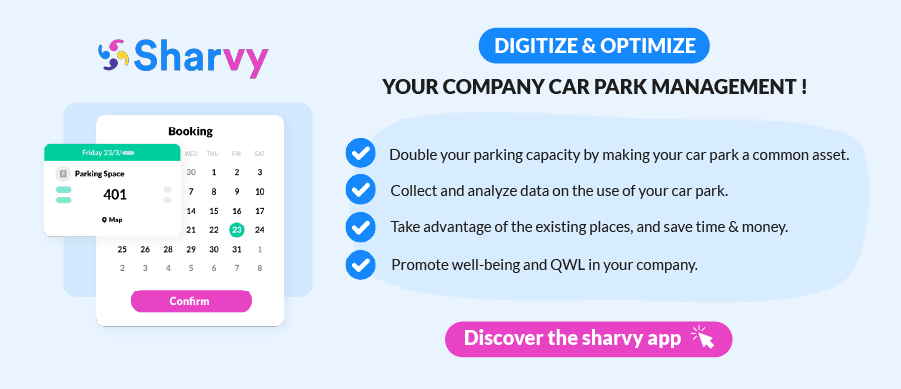
In this model, everything relies on a parking management app, such as Sharvy. Employees log in to the platform, specify their requirements (days of attendance, need for a charging point, any restrictions) and submit a request to reserve a parking space. In return, the system automatically allocates available spaces according to the rules defined by the company.
Note: this type of solution also allows certain spaces to be deliberately reserved for fixed allocation. For example, companies may choose to reserve spaces dedicated to senior management, certain strategic roles, or specific uses (regular visitors, service vehicles, etc.), whilst allowing the rest of the car park to be managed dynamically and fairly. This allows for a combination of overall flexibility and stability for certain internal needs.
The algorithm can then incorporate several parameters: fair rotation among users, prioritisation of certain groups (people with reduced mobility, pregnant women), quota management by team or department, and optimisation of available spaces based on absences or holidays.
The case of charging points is also integrated: slots can be reserved to avoid conflicts of use and maximise their availability, whilst ensuring a consistent distribution amongst electric vehicle users.
↪ The pros and cons.
The main advantage of this model is the balance between efficiency and fairness. Unlike the FIFO model, access to the car park no longer depends on arrival time, but on a structured and transparent system.
This enables better use of spaces, reduces internal friction, provides advance visibility for staff, and optimises the management of charging points.
On the other hand, this model introduces a certain degree of reliance on digital tools. It requires a clear framework, strong buy-in from teams and a precise definition of allocation rules to be fully effective.
↪ The economic benefits of this model.
Economically, this system transforms a passive cost into an optimised resource. The car park is no longer simply available; it is utilised to its full capacity.
Businesses reduce losses associated with unused or poorly allocated spaces and improve the overall occupancy rate. This also allows for better utilisation of existing infrastructure, without necessarily increasing the parking area.
This is a particularly attractive model for rationalising property costs and transitioning to more flexible uses.
↪ Which businesses is this model aimed at?
This model is particularly suited to companies facing significant pressure on parking spaces or significant variability in staff attendance (remote working, flex office, multi-site operations, etc.).
It is also suitable for organisations that wish to:
-
-
- Ensure perceived fairness among employees.
- Structure the use of mobility infrastructure.
- Integrate the management of electric vehicles.
- Avoid parking-related conflicts.
-
Ultimately, it is a model for companies that no longer want to be at the mercy of their car park, but to actively manage it as a strategic resource.
The parking credit management model.
↪ How this model works.
Each employee is allocated a certain number of credits over a given period (month, quarter, year). These credits can then be used to reserve a parking space.
These credits are primarily used to limit and structure the frequency of access. In practice, every time an employee uses the car park, a credit is deducted. The number of credits allocated depends directly on the rules defined by the company:
-
- Employees with more regular attendance may be allocated more credits.
- Employees with a hybrid attendance pattern may have an intermediate quota.
- Certain roles and functions may have specific rules (field teams, management, maintenance, etc.).
The aim is to create a clear and controlled hierarchy for car park access, without resorting to a fixed allocation of spaces or complex day-to-day management.
This system can also be combined with additional rules defined by the company, such as limiting the number of entries per week, restriction periods (peak days), or adjustments in line with internal mobility policies.
Ultimately, the car park becomes a space whose use is regulated by quantified access rights, tailored to the organisation’s profiles and needs.
↪ The pros and cons.
The main benefit of this access credit system is its ability to structure car park usage without having to manage each day individually. The company sets a clear framework (number of authorised entries), and the rest is automated. This greatly simplifies operational management.
For staff, the system also provides clarity: everyone knows their right to use the car park and can plan their visits accordingly.
But this model also has its limitations. It can create a perception of inequality between different staff categories if the rules for allocating credits are not clearly explained. It can also lead to difficult trade-offs (for example: « saving credits for later »), which may be viewed negatively in some organisations. Finally, it requires a clear and stable management framework to avoid misunderstandings.
↪ The economic benefits of this model.
From an economic perspective, the company no longer seeks merely to fill positions, but to control an overall volume of new hires.
This allows:
-
- Smoothing demand over time.
- Avoid over-use of the car park by certain user groups.
- Optimise overall usage without expanding the infrastructure.
- Better align the car park with HR policies.
In practice, this model allows for better control of pressure on the car park, whilst maintaining a degree of flexibility for employees.
↪ Which companies is this model aimed at?
This model is particularly suited to companies wishing to strictly regulate car park usage without getting bogged down in complex day-to-day management.
It is particularly suitable for organisations with a highly diverse workforce, such as managers, field teams and office-based staff, where the need for on-site presence varies significantly from one role to another.
It is also suitable for companies seeking to regulate on-site presence in a more comprehensive manner, by controlling car park access flows rather than managing each day individually.
This system also works very well in organisations that wish to limit excessive use and avoid imbalances in access between employees.
How do you choose the right model for your company car park?
The choice between FIFO, fair allocation or the credit system depends above all on one key factor: the level of pressure on the car park. The closer demand is to actual capacity, the more relevant managed models become. Conversely, if there are more than enough spaces, a simple approach like FIFO can still work without major friction.
Company culture must also be taken into account. Some organisations prioritise simplicity and autonomy, whilst others seek a more structured management approach, based on fairness, data and resource optimisation. The car park then becomes a direct reflection of how the company allocates its internal resources.
Finally, usage patterns play a key role: hybrid working, the rise of electric vehicles, multi-site operations, etc. The more varied the needs, the greater the value of a flexible model.
In conclusion
Corporate car park management is no longer a secondary issue: it now reflects very concrete challenges relating to organisation, fairness and resource optimisation. Each model follows a different logic, with its own strengths and limitations.
Ultimately, there is no single universal model, only choices that align with the level of parking demand, the company’s culture and its mobility objectives. The scarcer and more strategic the resource becomes, the more management must evolve towards structured systems.
Got a question? Check out the following FAQ!
Is the FIFO model still suitable today?
Yes, but only in situations where pressure on the car park is low. As soon as the number of spaces becomes insufficient, it quickly leads to inefficiency and frustration regarding arrival times.
Can several models be combined within the same company?
Yes. Hybrid approaches are common: a fair algorithm for the majority of spaces, a few fixed spaces for specific uses, and sometimes credit or quota rules for certain user profiles. You can easily set up this combination of models via the Sharvy app.
How are charging points managed in these models?
In managed or fair systems, charging points can be integrated directly into the booking and allocation logic, with dedicated time slots or priority rules depending on vehicle requirements.
Want to find out more? Check out our latest articles to stay up to date!

5 actions to reduce the carbon footprint of your company cafeteria!
Discover 5 simple & effective actions to reduce the carbon footprint of your company cafeteria and become a more sustainable company!

Improving QWL : 5 actions to take in your company!
Discover five concrete & effective actions to improve the QWL (Quality of Life at Work) of your employees!
Smart mobility : the future of urban mobility ?
The mobility ecosystem faces many challenges. However, smart mobility is opening up promising avenues of thought! Focus.