
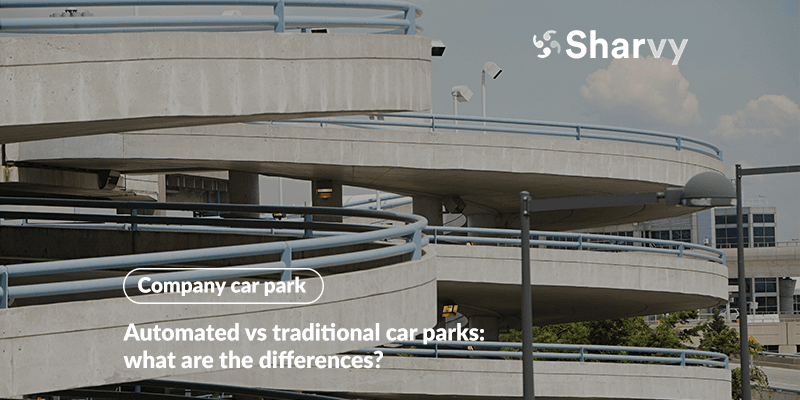
In the morning, everyone wants the same thing: to get to the office and park easily. Yet, in many companies, parking is still a source of frustration: reserved spaces that remain empty, car parks that are full on certain days, and a sense of unfairness among staff.
The reason? A management approach that is often very traditional: spaces allocated on an annual basis with little flexibility.
But with hybrid working and more dynamic offices, this model is quickly reaching its limits. More and more companies are therefore turning to a new approach: automated parking. Space booking, fair allocation, smart access: car park management is becoming simpler and more efficient.
But ultimately, what does this mean for your business? What are the limitations? The benefits? Let’s take a closer look.
What is a traditional ‘«’ company car park »?
1. How it typically works.
Traditional company car parks often rely on simple… but rigid rules. Each employee is allocated a parking space for the year, often based on their length of service and their role within the company. If the car park has fewer spaces than there are employees, then some are given priority. Access is often via a badge, and there are few tools to determine whether all spaces are actually in use.
It is a system based on predictability: everyone knows where to park, but flexibility is virtually non-existent. Visitors, interns and employees arriving unexpectedly often have to fend for themselves, whilst some spaces remain desperately empty all day long.
2. The limitations of the “traditional” company car park.
Whilst this model was adequate for a long time, it is now showing its flaws.
-
- Underused spaces: some remain empty despite genuine needs elsewhere.
- A sense of unfairness: some staff have fixed spaces, whilst others have to fend for themselves every day.
- Poor visibility: it is impossible to know in real time which spaces are available and which are occupied.
- Cumbersome administration: tracking allocations and managing badges and visitors is very time-consuming.
- Difficult to adapt to hybrid working: when some staff only come in a few days a week, the rigidity of the system becomes a real headache.
Ultimately, the traditional works… but not always as we’d like. It lacks flexibility, transparency and efficiency, especially in modern businesses where needs change rapidly.
What is an automated company car park?
1. How it typically works.
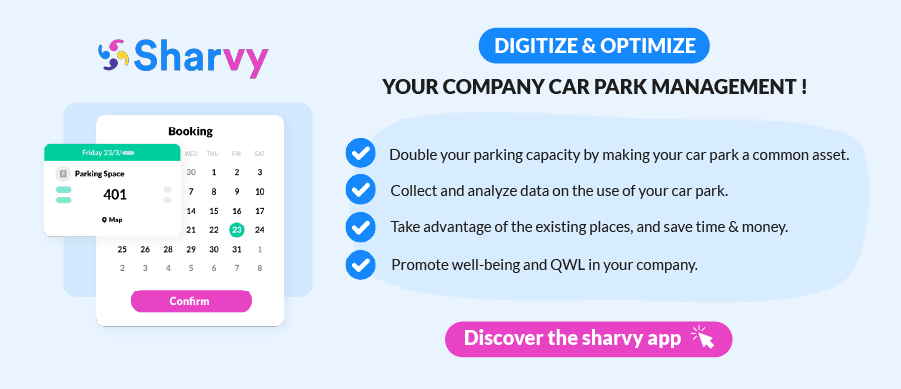
Very often, in this situation, the use of a company car park management app is essential. For example, the Sharvy solution. Today, it is already used by over 100,000 employees in companies such as Vinci, Nestlé and Engie to optimise the use of available spaces and simplify the journey to the office.
It’s very simple: every employee can book their parking space directly via the app, in just a few clicks, either for the same day or several days in advance.
But that’s not all: Sharvy also ensures fairness. Spaces are not allocated at random or based on seniority. The system takes into account booking history over the last 60 days to ensure everyone has balanced access to the car park. The result: no more frustration for those arriving « too late » and no more wasted spaces.
On arrival, the experience is seamless: the barrier opens automatically thanks to automatic number plate recognition (ANPR), via Siri and voice recognition, which allows the barrier to open only if a booking is active; otherwise, via a simple button
« Open the barrier » via the app. Consequently, every employee knows exactly where to park, without stress, without wasting time, and with the certainty that the system is fair for everyone.
2. The technologies used.
Behind this apparent simplicity, this car park relies on powerful digital tools:
-
- Booking apps: allow you to book a specific type of space (standard, electric, etc.) and view availability in real time.
- Smart allocation systems: optimise the use of spaces and ensure fairness among employees.
- Automatic number plate recognition (ANPR): fast, contactless access control.
- Dashboards & reporting: monitoring of occupancy, usage statistics & visibility of future needs.
- Integration with internal tools: can be connected to HRIS systems to automatically allocate spaces based on attendance.
With these technologies, the car park is no longer just a space to manage, but a smart service that simplifies life for everyone.
Automated car park vs. traditional car park: what are the main differences?
At first glance, a car park is just a car park. But in practice, the way it is managed can completely transform the employee experience and the efficiency of the space.
1. Parking space management.
In a traditional car park, spaces are generally allocated on a fixed basis. Once an employee has a space, it remains dedicated to them… whether they are present that day or not. The result: some spaces remain empty all day, whilst other employees are desperately trying to park.
With an automated car park, the approach is different: spaces are shared and allocated dynamically. Staff reserve their parking spaces based on their working days, which allows available spaces to be used much more intelligently. A single space can thus be used by several people throughout the week.
2. Fairness among staff.
In many companies, parking is still linked to status: senior management, managers and long-serving staff benefit from reserved spaces. Others often have to make do. This can create a sense of unfairness within teams.
An automated car park changes this approach. Thanks to smart allocation systems, such as the one used by Sharvy, spaces are distributed fairly. For example, the system can take into account booking history over the last 60 days to balance access to the car park among staff. This gives everyone a real chance of securing a space.
At the same time, the system also allows certain essential priorities to be maintained. Spaces can be reserved for people with reduced mobility (PRM), pregnant women, electric vehicles, as well as for specific company uses. These rules are built directly into the platform to ensure both fairness and respect for specific needs.
3. The occupancy rate of the company car park.
In a traditional company car park, the actual occupancy rate is often poorly understood… or not known at all. Most of the time, companies know how many spaces they have, but not how many are actually used on a daily basis.
Between staff working from home, travelling or simply absent, many reserved spaces remain empty for much of the time. Yet, as they are allocated on a fixed basis, they cannot be used by others. The result: a car park that appears full on paper, whilst in reality several spaces are unoccupied.
With an automated car park, the picture changes completely. Management tools allow for precise monitoring of car park occupancy: number of bookings, utilisation rates, busy days, no-show rates… Companies finally have concrete data to understand how their car park is actually being used.
At the same time, spaces are reserved only when staff need them. This encourages turnover and often allows more vehicles to be accommodated with the same number of spaces, without expanding the car park. A real driver of optimisation, particularly useful in a hybrid working environment!
4. The user experience.
With a traditional car park, the experience is sometimes… rather uncertain. Employees arrive in the morning without really knowing if there will be a space left, especially at peak times. Some drive round the car park for several minutes, whilst others end up having to park further away or improvise a last-minute solution. This lack of visibility can quickly become a source of stress and frustration right from the start of the working day.
Automated car parks completely transform this experience. Employees can book their space in advance via an app. This means they know, even before leaving home, that their space is waiting for them.
On arrival at the site, access is also smoother. Thanks to technologies such as the LAPI system, the barriers open automatically if a parking space reservation is confirmed. There is no longer any need to search for a badge or wait for an attendant to intervene.
5. The administrative management of the car park.
Finally, managing a traditional car park often involves a great deal of manual work: allocating spaces, managing badges, responding to requests, modifying access rights, and so on.
With an automated car park, much of this management is centralised and automated. Administrators have dashboards to monitor car park occupancy, adjust allocation rules and manage visitors. The result: less time spent on admin and greater visibility into actual car park usage.
So, when should you opt for an automated car park?
Car parks rarely become a strategic issue until the day they cause a problem. Tensions between colleagues, spaces that always seem to be taken, emails piling up requesting access, and so on. It is often these little daily frustrations that reveal it is time to rethink car park management!
Automated car parks really come into their own when usage patterns become more complex. This is particularly the case in companies where hybrid working has become the norm. When employees no longer come into the office every day, spaces allocated on an annual basis lose their purpose.
It also becomes particularly useful when the car park is regularly full on certain days. Without visibility into actual occupancy, companies often feel there is a shortage of spaces, whereas the problem mainly stems from how they are used.
Another common situation: when the issue of parking becomes a sensitive one internally. Feelings of unfairness, repeated requests, difficulties in allocating spaces, etc. In such cases, automation brings greater transparency and clear rules for everyone. The system acts as the arbiter, and decisions are no longer based solely on human judgement.
Finally, automated car parks are particularly relevant for companies wishing to improve the employee experience. Today, arriving at the office is part of the daily work routine. Being able to book a space in advance, enter the car park easily and park without stress helps make this experience much smoother!
In conclusion
Company car parks are no longer simply a space for parking cars: they are a key element of the employee experience and organisational efficiency. With the traditional model—rigid and often frustrating—spaces remain underused, frustrations mount, and getting to the office can become a real headache.
Automated parking completely changes the game. Thanks to booking, fair allocation and smart access, every employee knows a space is waiting for them, with complete transparency. Tensions disappear, morning stress evaporates, and the existing space is used to its full potential.
Any questions? Check out the following FAQ!
Is automated parking suitable for small businesses?
Yes. Even for a small car park, an automated system allows for better management of bookings, monitoring of occupancy and ensures fairness among employees. The flexibility offered saves time and brings peace of mind for everyone.
What are the benefits for the company beyond employee comfort?
Beyond staff well-being, the company benefits from optimised space, reduced internal conflicts, precise monitoring of occupancy and simplified administrative management, which translates into saved time and resources.
Want to find out more? Check out our latest articles to stay up to date!

5 actions to reduce the carbon footprint of your company cafeteria!
Discover 5 simple & effective actions to reduce the carbon footprint of your company cafeteria and become a more sustainable company!

Improving QWL : 5 actions to take in your company!
Discover five concrete & effective actions to improve the QWL (Quality of Life at Work) of your employees!
Smart mobility : the future of urban mobility ?
The mobility ecosystem faces many challenges. However, smart mobility is opening up promising avenues of thought! Focus.
Subscribe to our newsletter!
PARKING & WORKPLACE MANAGEMENT SOLUTION
Car park management - Charging points monitoring - Desk booking - Booking by time slots



LABELS & COMMUNITIES




SUBSCRIBE TO THE NEWSLETTER
Receive the latest Parking & Workplace trends by email once a month.

