
The company car park is the very first impression of the day. It’s the one that can put you in a good mood, or conversely, annoy you right from the start. A barrier that doesn’t respond, a queue that forms, people glancing in their wing mirrors. Nothing dramatic, but enough to create unnecessary tension.
But what if it were more than just a minor detail? Behind these minor annoyances, there is often a rigid access system, designed for a bygone era. A time when everyone had their designated spot, when traffic flows were predictable, and when needs remained constant.
Today, habits have changed. Staff no longer all arrive at the same times, visitors are more frequent, and usage patterns are more flexible. Yet the car park entrance often remains unchanged.
So a question arises: what if this simple access point were to become smarter? We explore this in this article.
A quick reminder: what is the IoT, and how does it apply to car parks?
The IoT (Internet of Things) refers to all physical objects capable of connecting with one another and transmitting information in real time. In other words, everyday objects that no longer function on their own, but « communicate » with a central system to provide a smarter service.
When applied to car parks, this radically changes the way they are managed. A parking space is no longer just a physical space: it can be detected, tracked and integrated into an overall system. A barrier is no longer just a mechanical entry point: it can receive instructions based on a specific situation. And the entire car park becomes a source of live data on its occupancy and usage.
In practical terms, this allows us to know in real time what is happening on site: which spaces are free, who is entering, who is leaving, and at what time. We are moving from to a system capable of adapting to the company’s actual needs.
The company car park: a daily reality more complex than it seems?
↪ The company car park as the first and last point of contact of the day.
We don’t really pay much attention to it, and yet it’s often where everything begins. The company car park is that brief moment when we transition from the journey to the working day. A few minutes are enough to set the tone.
A barrier that takes a little too long to open, a moment’s hesitation over which lane to take, a car behind you waiting… and before you know it, a little tension builds. Nothing serious. But it is precisely these kinds of details which, repeated day after day, eventually take their toll.
This moment of arrival also has a wider impact than it might seem.
-
- For an employee, it influences how the day begins.
- For a visitor, it gives a first impression of the company, sometimes stronger than any speech.
Smooth access conveys simplicity and organisation. Complex access, on the other hand, tells a different story. And ultimately, that may be the real issue : the car park is not just a functional space. It is an experience of entering the company. An experience we go through every day, but one we rarely think to improve. This is where the IoT can make a difference.
↪ Access control systems that are (still) too rigid.
If arriving at the company car park can sometimes cause friction, it is often because access control systems haven’t really kept pace with changing habits.
For a long time, everything relied on simple, stable systems: an allocated space, a badge, a remote control, a list of authorised users. These were effective solutions in a context where habits were also stable. The same people, the same timetables, the same needs every day.
But today, that framework no longer exists. Not all staff come into the office every day. Work patterns are hybrid, attendance is variable, and visitors are more frequent and less predictable. And yet, access tools have changed very little.
Consequently, we are constantly adapting. We add exceptions, create temporary authorisations, deal with a growing number of badge requests, and manage forgotten, lost or duplicate badges, and so on. Each individual situation may seem trivial, but taken together, they reveal a certain rigidity in the system.
This mismatch creates a form of invisible friction: the organisation functions, but at the cost of constant effort. And this is often where the real question arises, not « does it work? », but rather « could it be simpler? ».
The arrival of the IoT in company car park access control.
It is often these little everyday frustrations that ultimately drive change. When access badges pile up, access rights need constant adjustment and rules become hard to follow, a different approach gradually becomes necessary: making the system more responsive and smarter.
This is precisely where the IoT is a game-changer.
In the case of access control, it is no longer simply a matter of opening and closing a barrier. It is about enabling it to understand the context of an access event: who is arriving, when, under what authorisation, and under what conditions. In practical terms, a car park barrier can now be linked to a connected module capable of communicating in real time with a car park management platform.
↪ A connected barrier, which opens with a single gesture, like a phrase.
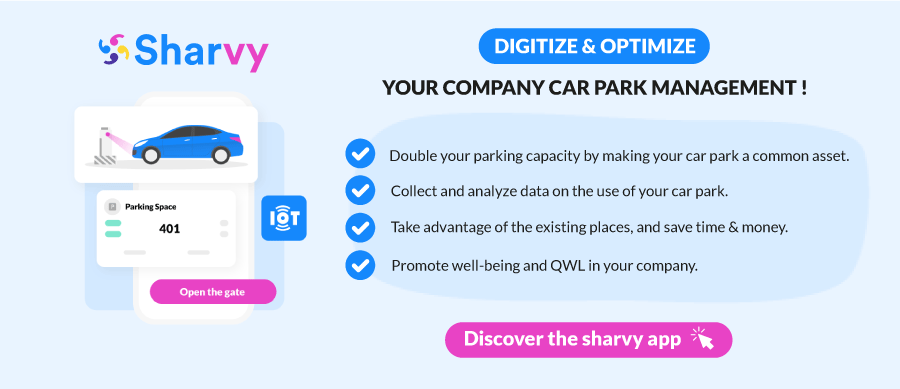
In practical terms, access to the car park becomes much more straightforward thanks to the addition of an IoT module. An employee can open the barrier from the chosen car park management app (e.g. Sharvy) with a single tap. No need to search for a badge, no special steps required: one click, and access is granted if there is a confirmed booking. It is also possible to use voice commands, with a voice assistant such as: « Siri, open the barrier». The idea is the same: to remove the hassle and get straight to the point when accessing the company car park.
↪ A smoother entry process, linked to the booking.
When a space is booked via the dedicated app, this booking becomes the key to accessing the car park upon arrival. In practice, when the vehicle arrives at the barrier, the system simply checks within seconds whether a booking is active and valid at that precise moment. If so, the employee opens the barrier with a single button press « Open the barrier» – just like using a voice assistant.
The experience therefore remains very seamless: you book, you arrive, and the barrier opens at the right moment. No badge is required.
If no booking has been made, the process changes completely. There is no open button available in the app, and voice commands (such as « Siri, open the barrier for me ») do not trigger access either.
This ensures that the car park remains reserved for users who have actually planned their visit, and prevents unauthorised access.
↪ Much simpler management for the company.
Behind the smooth experience for staff lies an equally significant change for the business: car park management is finally simple, transparent and largely automated.
Whereas teams previously had to manage badges, individual access rights, and ad-hoc requests such as last-minute exceptions, everything is now centralised in a single system. Access is no longer granted on a case-by-case basis: it is directly linked to actual usage, such as a booking or a right defined in advance.
This significantly reduces repetitive tasks. There is no longer any need to manually create or remove access rights every time an employee arrives or leaves, nor to manage forgotten badges or urgent requests on the morning itself. The system applies the rules automatically, without the need for daily intervention.
Another key point: visibility. The company knows who is using the car park, when, and under what conditions. This allows for a better understanding of usage patterns, the ability to adjust rules if necessary, and the optimisation of available space without having to « guess » what is happening on the ground.
Finally, this simplification has a direct impact on internal teams (HR, facilities management, office management). They spend less time managing operational issues and can focus on higher-value-added tasks.
When these practices become a reality with solutions like Sharvy.
It is precisely in this type of operation that solutions like Sharvy come into their own.
Sharvy does more than just simplify access to the car park; it also introduces a fairer system for allocating spaces. Behind the app, a fairness algorithm organises priorities according to criteria defined by the company: employees requiring regular attendance, people in specific circumstances, such as pregnant women and those with reduced mobility, and certain one-off emergencies.
The idea is not to make things more rigid, but rather to distribute a limited resource more effectively by taking into account the human realities of everyday life. Not everyone starts from the same point, and the system allows this to be reflected in a structured and transparent way.
On arrival, the experience remains simple: once a space has been allocated, the employee presses a button in the app to open the barrier and access the car park. But behind the scenes, it is a whole system of fairness that ensures this space is available to the right person at the right time.
This system creates a sense of consistency: the rules are clear, the priorities are understood, and access to the car park no longer depends on seniority or chance, but on an organisation designed to be both smooth and fair.
In conclusion
We tend to view the car park as a mere functional space, almost secondary to a company’s day-to-day operations. Yet it is often the first and last point of contact with the site each day, and therefore a moment that directly influences the experience of employees.
What emerges from this evolution is less a question of technology than one of fluidity. When access becomes simpler, when rules are better adapted to real-world usage, when constraints disappear in favour of a smarter system, everyday life changes quietly but permanently!
The IoT plays a key role here: it enables a physical space to be linked to specific uses, in real time. And when combined with tools such as Sharvy, it paves the way for more flexible, transparent and fairer management of corporate car parks.
Ultimately, true transformation isn’t spectacular. It’s measured in those little moments that disappear: pointless waiting, uncertainty at the entrance, the morning hassle. And that’s often where the impact is greatest.
Got a question? Check out the following FAQ!
Is the IoT complicated to implement in a corporate car park?
No, the IoT does not require a complete overhaul of the existing infrastructure. It is generally integrated in stages (sensors, connected access systems, management platforms), allowing for a gradual roll-out without disrupting the site’s operations.
Does this type of solution completely replace badges or remote controls?
Not necessarily. Some companies choose to keep them as a supplement, but the main aim is to reduce their use as much as possible in favour of simpler, digital solutions, such as Sharvy.
Does the system also work for external visitors?
Yes, and it’s actually one of the most useful day-to-day applications. Visitors are no longer managed « separately, whether for»s or emergencies. They can simply be integrated into the same system as staff members.
In practical terms, the company can create temporary access passes for a visitor, with very specific conditions: a date, a time slot, or even a limited duration. Access is therefore strictly controlled, without the need for a permanent badge or complex manual management on the day.
In some cases, this access can also be linked to a parking space reservation. The visitor is then allocated a pre-identified space, which avoids confusion on arrival and keeps traffic flowing smoothly on site.
The aim remains the same: to welcome external visitors smoothly, whilst maintaining precise control over who enters, when, and under what conditions.
Want to find out more? Check out our latest articles to stay up to date!
How can your inter-company restaurant adapt to teleworking?
Teleworking : how can you manage the number of people using your inter-company restaurant & adapt your offer to new working habits? Focus.
Change management : how to facilitate the adoption of a new tool?
What are the essential steps to facilitate change management in your company ? Our advice and best practices can be found here.
Commute from home to work : a change in trends to consider ?
Commute from home to work : what trends can be observed? What are the risks? How can they be improved? Focus in this article.