

Companies have never shared their spaces so much. Between flex office, company car parks and electric vehicle charging stations, uses are multiplying… and with them, monitoring and billing issues. Who uses what? When? And according to what rules?
In some countries, employees can be billed simply for parking at their workplace. Elsewhere, it is electric vehicle charging that must be accurately tracked. The problem is not so much the billing itself, but the ability to access reliable, centralised and usable data.
It is in this context that tools such as Sharvy come into their own.
In this article, we will look at why multi-purpose billing has become a real challenge for businesses, and how intelligent usage management can significantly reduce its complexity.
The complexity of multi-use billing in businesses.
Billing can quickly become a headache for businesses and site managers. Between charging stations, flexible offices, car parks, etc., each usage has its own rules and requirements. Understanding this complexity is essential to grasping the value of a centralised solution such as Sharvy.
1. The different uses to be managed.
↪ Electric charging stations.
With the proliferation of electric vehicles, businesses and managers must provide accessible charging stations in company car parks and then accurately track their use. Billing may vary depending on charging time, power delivered, and the user’s subscription. Without the right tool, it becomes difficult to track each charging session and issue an accurate and transparent invoice.
↪ Office spaces (co-working, flex office).
Shared or flexible offices also require careful management of bookings and usage. Some users book spaces by time slot, others by the day or week. Billing must therefore be flexible and accurately reflect the duration and type of use. Errors or approximations can lead to conflicts and a poor user experience.
↪ Company car parks.
In many countries, particularly in Europe (e.g. Luxembourg), some companies charge their employees for parking spaces, especially in urban areas where parking is limited and expensive. Billing is not limited to a simple monthly subscription: it can vary according to the type of space (indoor, outdoor, premium), the duration of use, and even the frequency of attendance.
Companies therefore have to manage different profiles: employees with subscriptions, those who use the car park occasionally, and visitors. Without a centralised system, keeping track of all these transactions quickly becomes complicated.
2. Problems encountered.
↪ Tedious manual management & frequent errors.
Some companies try to manage billing using Excel files. However, this approach has several limitations:
- Wasted time: teams spend many hours collecting data, calculating amounts and generating invoices.
- Frequent errors: incorrect entries, missed invoices, double invoicing, etc.
- Difficulty adapting: adjusting rates or integrating new uses becomes a complex and slow process.
These difficulties show that manual invoicing is no longer suited to the current needs of businesses, especially when several departments are involved.
↪ A proliferation of billing platforms.
In many organisations, each type of usage (charging stations, flexible offices, car parks) is managed by different software. This fragmentation creates several difficulties:
- Teams have to navigate between several interfaces to track consumption and generate invoices.
- Data consolidation becomes time-consuming, as information from different systems must be retrieved, compared and cross-referenced.
- The risk of inconsistencies between platforms increases, which can lead to disputes with employees.
The proliferation of tools complicates day-to-day operations and limits overall visibility of usage and revenue.
↪ Complex tracking of payments and consumption.
Even when billing is partially automated, tracking payments and consumption remains a challenge.
First, data must be cross-referenced to determine who used which resource, on what date and at what rate. However, there may be tracking errors that can lead to unpaid bills or incorrect refunds. Not to mention that financial reports are often fragmented and difficult to analyse, which complicates decision-making and revenue management.
For company car parks, for example, accurately tracking the spaces used by employees and billing correctly according to the type of use can quickly become a headache, especially in countries where payment for parking spaces is mandatory.
The Sharvy app: an all-in-one solution?
Faced with the growing complexity of usage and the fragmentation of tools, companies need above all a clear and centralised view of the use of their spaces and services. This is precisely where Sharvy stands out.
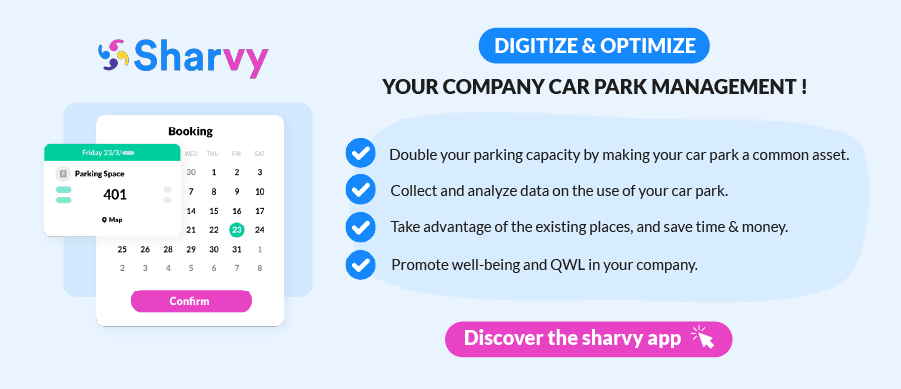
Sharvy offers a single interface for managing all site usage, regardless of the services offered:
- Reservation of parking spaces, whether standard or equipped with a charging station.
- Precise monitoring of charging stations: users, sessions, kWh consumption, duration of use, any incidents.
- Reservation of workspaces: offices and coworking spaces, by time slot, half-day or full-day.
- Management of users and access rights, according to profiles (employees, visitors, service providers).
All this information is centralised in a single tool, providing a comprehensive, real-time overview of usage. This centralisation is essential for ensuring the reliability of the data needed to establish clear and fair billing rules.
Sharvy also simplifies transaction management and access control. Thanks to its integration with payment solutions such as Stripe and access control systems, the application links usage, authorisation and payment, while reducing manual intervention.
In concrete terms, how does Sharvy simplify each use?
Let’s take the case of an international company located in a large European city, where parking spaces are billed to employees and charging stations are available.
Before Sharvy, management teams had to cross-reference several tools to reconstruct usage: reservations on one side, electricity consumption on the other, and actual employee presence elsewhere. Billing was then based on estimates or manual reprocessing, with a high risk of errors and disputes.
With Sharvy, each use is automatically recorded as it occurs. When an employee reserves a parking space equipped with a charging station for a day, the application associates the reservation with the user, records the duration of occupancy and accurately tracks consumption in kWh.
At the end of the month, this data is consolidated: the finance department knows exactly how many days the space was used, how much energy was consumed and what rates to apply for billing. They therefore have an overview of the whole process, but it is Sharvy that manages everything automatically.
Automatic notifications can be sent to users to inform them of amounts due or upcoming payments, reducing manual exchanges and misunderstandings.
In this context, Sharvy is not positioned as a billing tool, but as a reliable data foundation that makes billing possible, fair and transparent.
In conclusion
As companies diversify their services (car parks, charging stations, etc.), the question is no longer just about offering these services, but about managing them with precision. Multi-purpose billing is simply a direct consequence of a broader challenge: having reliable, centralised and usable data.
Sharvy meets this need by structuring actual uses, providing visibility and establishing a clear framework for fair and transparent billing rules, without adding to the burden of existing processes. By giving teams back control over their spaces and services, Sharvy enables businesses to gain in efficiency, fairness and peace of mind.
Any questions? Check out the FAQ below!
Is it possible to define different rules according to user profiles?
Absolutely. Sharvy allows you to differentiate access and usage rules according to profiles: employees, visitors, service providers, managers or directors. This allows you to apply specific conditions (free access, quotas, priorities, rates) according to each user’s role and company policy.
How does Sharvy help prevent abuse or misuse?
By linking each booking and each use to an identified user, Sharvy guarantees complete traceability. This transparency discourages misuse and allows teams to quickly detect anomalies or behaviour that does not comply with internal rules.
Can we change the rules of use without impacting users?
Yes. Rules can be adjusted at any time by management teams (new rates, time slots, priorities, quotas) without disrupting the user experience. Sharvy thus adapts to organisational or regulatory changes.
Want to learn more? Check out our latest articles to stay up to date!
How can your inter-company restaurant adapt to teleworking?
Teleworking : how can you manage the number of people using your inter-company restaurant & adapt your offer to new working habits? Focus.

Change management : how to facilitate the adoption of a new tool?
What are the essential steps to facilitate change management in your company ? Our advice and best practices can be found here.
Commute from home to work : a change in trends to consider ?
Commute from home to work : what trends can be observed? What are the risks? How can they be improved? Focus in this article.
Subscribe to our newsletter!
PARKING & WORKPLACE MANAGEMENT SOLUTION
Car park management - Charging points monitoring - Desk booking - Booking by time slots



LABELS & COMMUNITIES




SUBSCRIBE TO THE NEWSLETTER
Receive the latest Parking & Workplace trends by email once a month.

