
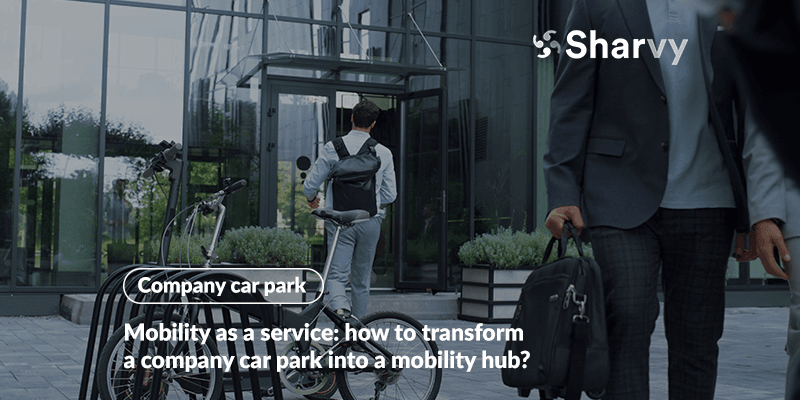
Traditionally designed as simple vehicle storage spaces, company car parks are, in fact, a largely untapped strategic mobility lever. In a context where employees’ modes of transport are diversifying and the ecological transition is becoming imperative, these spaces can be reimagined as genuine mobility hubs.
The concept of Mobility as a Service (MaaS) offers companies a unique opportunity: to transform their car park into a central mobility point, integrating shared bikes and scooters, charging stations, shuttles, and company fleets.
Beyond mere space optimisation, this approach enhances the employee experience, strengthens the company’s appeal, and contributes tangibly to its environmental commitments.
But what are the steps and solutions required to move from a traditional company car park to a modern mobility hub? What factors determine success or failure? This article explores these questions in detail.
Workplace mobility is evolving: from traditional car parks to “Mobility as a Service”.
For a long time, corporate mobility was mainly addressed from the perspective of car storage. The car park’s primary function was to accommodate employees’ vehicles (car policy), without much thought given to optimising the space or the overall mobility experience.
It was essentially a passive space, dedicated to storing cars, with little consideration for the diversification of transport modes or environmental impact.
Today, this approach is largely outdated. Companies are beginning to see their car parks not as mere collections of spaces, but as strategic levers capable of transforming employee mobility.
In this context, adopting a MaaS vision allows companies to rethink the use of the car park by integrating multimodal solutions : shared bikes and scooters, electric vehicle charging stations, company shuttles, fleets of vehicles, and more. The goal is to create a service hub where every employee can choose the ideal mode of transport for their commute.
This transition is not limited to installing infrastructure; it also relies on digitalising services, supporting users, and creating a seamless and attractive experience.
Why transform a company car park into a mobility hub?
Transforming a “traditional” car park into a mobility hub addresses more than just logistical challenges. It brings tangible benefits for employees, the company, and the environment.
- For employees, a mobility hub offers greater flexibility and comfort. No more frustrations searching for a parking space or being forced into inconvenient travel. Alternatives such as shared bikes, scooters, and shuttles allow each journey to be optimised according to personal preferences and constraints. This makes the mobility experience more enjoyable and efficient, directly contributing to employee wellbeing and satisfaction.
- For the company, these hubs undoubtedly enhance attractiveness and brand image. In a competitive market for attracting and retaining talent, offering diversified and responsible mobility is a strategic advantage. It also optimises available space, reduces costs associated with expanding car parks, and highlights CSR commitments to stakeholders.
- For the environment, the impact is significant. Encouraging the use of electric vehicles, carpooling, and soft mobility options helps reduce CO₂ emissions, decreases road congestion, and supports energy transition objectives. Over the long term, the car park becomes a concrete tool for reducing the company’s carbon footprint.
In short, transforming a car park into a mobility hub simultaneously addresses human, economic, and environmental challenges, turning a once-ordinary space into a genuine catalyst for change.
What are the key steps for successful MaaS implementation?
↪ Step 1: Diagnosis & needs analysis.
Before taking action, it is essential to understand employees’ mobility habits. Which transport modes are most used? Which flows should be prioritised? What proportion of electric versus conventional vehicles? How many charging points are necessary? This analysis ensures infrastructure is appropriately sized and the hub genuinely meets employees’ needs.
↪ Step 2: Defining the multimodal strategy.
Based on collected data, the company can determine which solutions to integrate: shared bikes and scooters, vehicle fleets available by reservation, internal shuttles, communal charging stations, etc. The objective is to create a complementary environment, where each transport mode fits into a smooth and coherent journey for users.
↪ Step 3: Physical layout.
Naturally, the car park must be redesigned to accommodate different types of mobility. This involves creating dedicated zones: electric vehicle charging points, secure stations for bikes and scooters, and pick-up/drop-off areas for shuttles and shared cars. Signage and safety measures should also be optimised to facilitate daily use and avoid conflicts between transport modes.
↪ Step 4: Digitalisation & MaaS Application.
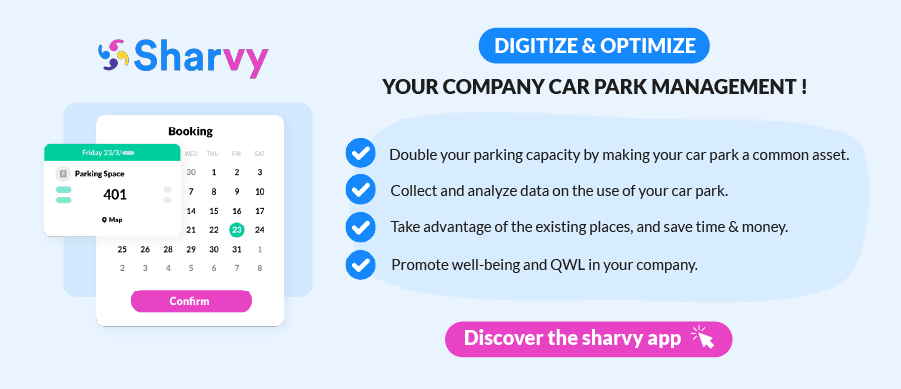
Integrating a company car park management solution is a major asset. A centralised application (such as Sharvy) allows employees to book a car park space, a charging station, a bike, a scooter, or a shuttle, check availability, and even combine multiple transport modes to optimise their journey. Digitalising via a SaaS solution creates a smoother experience and naturally encourages the adoption of alternatives to individual car use.
This is particularly relevant for CSR-minded companies, considering that over 75% of employees still commute by car, and that at 8 am, 89% of cars carry only one occupant.
↪ Step 5: Support & communication.
Finally, success depends on employee buy-in. Clear communication about new services, user training, and incentives to encourage soft mobility are essential. Support should be gradual, with regular feedback to adjust infrastructure and services according to actual usage.
Checklist: Innovative and trending MaaS solutions for companies.
Several solutions can be deployed to maximise the hub’s impact and appeal:
- Shared Charging Stations: Installing charging points in the car park meets multiple needs simultaneously: powering electric vehicles, promoting their use, and optimising available space. This approach supports sustainable mobility while reducing the company’s carbon footprint.
- Micro-Mobility Stations: Shared bikes and scooters provide a quick, eco-friendly alternative for short journeys. They can be integrated within the car park or in its immediate vicinity for easy access.
- Company Car Park Management App: A single digital solution manages all mobility options: bookings, fair allocation, access control, service monitoring, billing, and multimodal planning. The user experience becomes intuitive and centralised, encouraging regular use of alternatives to private vehicles.
Among Sharvy’s clients, several pioneering companies have already transformed their car parks into full mobility hubs, combining shared charging points, internal carpooling, and a digital platform guiding employees in choosing the most suitable transport mode.
Ultimately, these initiatives demonstrate that a company car park can become a strategic mobility node, serving efficiency, attractiveness, and sustainability.

In conclusion
There is no doubt: rethinking your company car park as a mobility hub transforms a simple space into a strategic lever for the organisation. It anticipates future mobility needs, enhances attractiveness for talent sensitive to sustainable solutions, and generates cost savings through better use of infrastructure.
By combining shared charging stations, electric fleets, and micro-mobility options, a company does more than offer alternatives to cars: it creates an innovative ecosystem capable of adapting to changing travel patterns and turning environmental engagement into a tangible benefit for all.
Any questions? Check out the following FAQ!
What is a company mobility hub?
A mobility hub is a centralised space where multiple transport modes coexist for employees: cars, shared bikes and scooters, company shuttles, and electric vehicle charging stations. It combines flexibility, efficiency, and sustainability for professional and commuting journeys.
How can employees be encouraged to use these solutions?
It is essential to provide a simple, intuitive experience: easy booking via an app, guaranteed vehicle and charging point availability, communication of benefits (time savings, cost, environmental impact), and possibly incentives such as rewards for using sustainable modes or priority parking for carpoolers.
What are the risks of failure?
The main pitfalls include inadequate infrastructure, poorly sized services, lack of communication and support, low employee adoption, and insufficient monitoring to adjust the hub according to actual usage.
Want to learn more? Check out our latest articles!
4 mistakes to avoid when digitising your company car park
Why digitise a company car park? What mistakes should be avoided when integrating a car park management solution?
Sharvy vs Excel: why automate your car park management?
What are the advantages of automating your company car park management? How do you go about it? Explanations & solutions!
5 mistakes to avoid when integrating car park management software!
What are the 5 most common mistakes to avoid before and during the integration of parking management software? Focus!
Subscribe to our newsletter!
PARKING & WORKPLACE MANAGEMENT SOLUTION
Car park management - Charging points monitoring - Desk booking - Booking by time slots



LABELS & COMMUNITIES




SUBSCRIBE TO THE NEWSLETTER
Receive the latest Parking & Workplace trends by email once a month.

