
When it comes to quality of life at work, companies generally think of remote working, management, and office layout. Yet a much more mundane detail can also tip the balance: company car parks.
For many employees, the day doesn’t begin when they sit down at their desk, but when they arrive at the company car park. Searching for a space, worrying about being late, driving round in circles for a few minutes too long. These little daily stresses can be enough to start the day already feeling annoyed.
Yet this moment influences mood, stress levels and the mindset with which we start our working day. And when this situation repeats itself every morning, it can gradually weigh on employees’ overall experience.
So, is company parking really just a logistical detail? Or could it, on the contrary, play a far more significant role in job satisfaction than we realise? Let’s take a closer look.
1. Car parks as a source of stress even before the day begins.
↪ The stress of the commute.
It often all starts before you even leave the house. You check the time, think about the traffic, and how long it will take to park. And a nagging question creeps in: will I find a space easily today?
This phenomenon has a name: anticipatory stress. It is the tension that arises when we anticipate a potentially complicated situation. In the case of the commute, all it takes is a company car park that is often full or difficult to access to turn the morning departure into a source of anxiety.
This feeling is widely shared. A recent survey reveals that more than one in two employees dreads the problems associated with their daily commute, whether it be traffic, delays, or difficulties accessing their workplace.
So, when every morning begins with these little worries: will I be late? How long will I have to drive round looking for a parking space? The day already starts with a higher level of stress.
↪ The psychological impact of commute time.
Beyond the anticipation, the duration of the journey itself plays a significant role in well-being. The longer the journey, the more mental fatigue and frustration it can cause.
According to a study conducted by HR specialist Securex, one in three motorists say they feel stressed during their commute, particularly when it is unpredictable or subject to daily hazards.
Little by little, these minutes spent in traffic or looking for a parking space can weigh on one’s mood and motivation. What should be a simple transition between home and work then becomes a moment of daily tension, which influences the state of mind with which one arrives at the office.
2. Car parks: a real driver of Quality of Life at Work (QLW)?
↪ Company car parks: a significant impact on the employee experience.
Even today, the car remains the dominant mode of transport for commuting to work.
In France, 75% of the working population use their own car for their commute. This means that the vast majority of employees start their day by arriving at the company car park.
And when this car park is full or poorly organised, the consequences are quickly felt. On average, 36% of motorists frequently arrive late due to a lack of available parking spaces, according to a recent study conducted by Sharvy.
These situations may seem trivial, but they have a tangible impact on teams’ daily lives: stress upon arrival, frustration, wasted time, and so on. All these factors weigh heavily on how work is perceived!
↪ So, what solution can turn parking into a lever for improving quality of life at work?
The good news is that parking is also a relatively simple area for companies to improve. All the more so given that, according to the United Heroes study, 22% of employees consider parking to be one of the easiest levers for their employer to pull to improve their quality of life at work.
This is easily explained: unlike complex organisational changes, improving access to parking can have an immediate impact on employees’ day-to-day experience.
More and more companies are therefore beginning to rethink the management of their car parks. Digital solutions such as Sharvy now make it possible to book a space in advance, share available spaces and optimise their use, particularly in hybrid working environments where employees do not come into the office every day.
This solution is already used by over 70,000 employees at companies such as Vinci, Engie, Nestlé and Cegedim… The aim is to optimise the use of available spaces and simplify the journey to the office.

3. Car parks as a tool for attracting and retaining talent.
In a climate where companies are seeking to attract and retain the best talent, the employee experience is becoming a key strategic lever. Salary, flexibility and the working environment are important, but so are more practical day-to-day factors, such as how easy it is to get to work.
After all, for an employee, accepting a job depends not only on the nature of the role, but also on how easily they can get there.
Studies on mobility confirm this: the commute directly influences career decisions. According to a study conducted by ADEME, nearly one in two workers considers the distance between home and work to be a key factor in choosing a job.
There is no doubt about it: when getting to the office is difficult, it can become a barrier to a company’s appeal. Conversely, an easily accessible site, with suitable parking facilities, can be a tangible benefit in the experience offered to employees.
Some studies go even further. An analysis of workers’ mobility shows that employees with longer or more demanding commutes are more likely to consider changing jobs, particularly to improve their work-life balance.
In this context, parking becomes an unexpected lever for employer branding. Offering solutions to simplify the journey to the office (e.g. smart and fair car park management, space booking, sharing of available spaces, etc.) helps reduce daily friction and improve the perception of the company.
It is precisely with this in mind that some organisations are turning to solutions such as Sharvy.
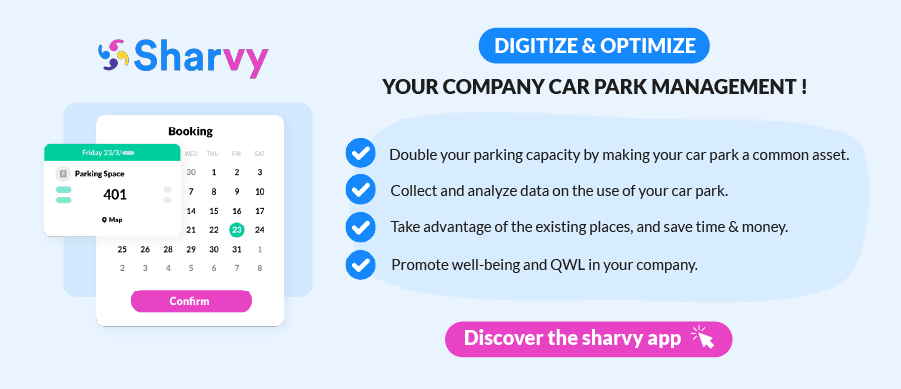
So, how can we rethink car park to improve job satisfaction?
Improving the parking experience doesn’t necessarily mean building new car parks!
In many companies, the real challenge lies instead in optimising existing spaces. With the rise of remote working and hybrid working arrangements, some spaces remain unoccupied for part of the time whilst other employees struggle to find a space.
Implementing a (fair) parking space booking system allows for a better distribution of these spaces and helps avoid unnecessary overcrowding.
Today, corporate car parks are evolving into smart spaces, driven by various technologies: apps allow employees to book a space in advance, occupancy sensors identify spaces that are actually occupied, LAPI systems and IoT modules at entrances and exits, as well as dynamic management systems, automatically reallocate available spaces.
Some solutions go even further by integrating these features into HRIS systems, so that car park usage can be adapted to the days when staff are present. The result: smoother parking, less stress on arrival and better use of existing infrastructure.
In conclusion
We often talk about transforming workspaces, the employee experience and quality of life at work. Yet some improvements do not require major projects or heavy investment. Sometimes, it is simply a matter of looking at the most ordinary moments of daily life in a different light.
Arriving at the office is one such moment. This moment, often seemingly mundane, nevertheless shapes the mindset with which an employee starts their day.
A car park that appears full, minutes wasted looking for a space, or the fear of arriving late can turn this simple journey into a source of stress. Conversely, a smooth car park management system can help create a more relaxed atmosphere from the very first minutes of the day. This is thanks to solutions such as Sharvy.
Got a question? Check out the following FAQ!
Is a lack of parking spaces still the main cause of parking problems?
Not necessarily. In many cases, the problem stems more from poor allocation of spaces. With remote working and hybrid working patterns, some spaces remain empty whilst others are in high demand. Better organisation and more dynamic management can already resolve a large part of the issues.
Can car park management improve a company’s image?
Indirectly, yes. Well-designed office access helps project an image of a company that cares about its employees’ day-to-day lives. For visitors, candidates and new employees, this initial experience can also influence their overall perception of the organisation.
Is company car parking really a strategic issue for HR?
Yes, because it directly affects employees’ day-to-day lives. Modern HR policies are increasingly focused on the overall employee experience, which begins the moment they arrive at the workplace. Simple and seamless access to the car park can help reduce daily frustrations and improve perceptions of the working environment.
Want to find out more? Check out our latest articles!
How can your inter-company restaurant adapt to teleworking?
Teleworking : how can you manage the number of people using your inter-company restaurant & adapt your offer to new working habits? Focus.

Change management : how to facilitate the adoption of a new tool?
What are the essential steps to facilitate change management in your company ? Our advice and best practices can be found here.
Commute from home to work : a change in trends to consider ?
Commute from home to work : what trends can be observed? What are the risks? How can they be improved? Focus in this article.
Subscribe to our newsletter!
PARKING & WORKPLACE MANAGEMENT SOLUTION
Car park management - Charging points monitoring - Desk booking - Booking by time slots



LABELS & COMMUNITIES




SUBSCRIBE TO THE NEWSLETTER
Receive the latest Parking & Workplace trends by email once a month.

