
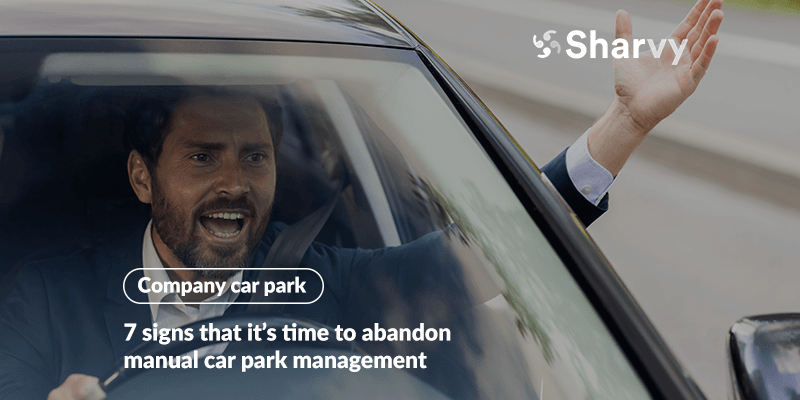
Have you ever felt that your company car park management was starting to slip out of control? Emails piling up, employees competing for the same spaces, a car park marked as “full” while several bays remain empty…
If this sounds familiar, you’re not alone. Many organisations still underestimate the time and effort consumed by manual processes, until managing the car park becomes a real headache.
Before these everyday frustrations turn into ongoing problems, it’s worth asking an important question: is your current system truly suited to the needs of your business today? And more importantly, is it ready to support your company’s growth?
In this article, we help you gain clarity by highlighting seven clear signs that it may be time to leave Excel spreadsheets and handwritten waiting lists behind.
Sign #1: You’re losing a considerable amount of time on day-to-day coordination.
If company car park management is taking up a disproportionate amount of your working day, it’s the first warning sign. Responding to requests scattered across emails, internal messages and impromptu conversations quickly becomes time-consuming.
Worse still, it often involves people for whom this isn’t actually part of their role. Constantly juggling priorities can turn a simple task into a source of ongoing frustration. When a process takes more time than it should, it’s a clear sign that it needs to be rethought.
Sign #2: Employees are complaining about a lack of fairness.
A company car park touches on something surprisingly sensitive: the sense of fairness. When some employees almost always get a space while others seem condemned to chance, tensions inevitably arise.
You’ve probably noticed it yourself: nothing undermines motivation faster than a system perceived as unfair. Manual management, often opaque, makes it difficult to apply consistent rules. When disputes become recurring, it’s a clear sign that a more transparent approach is needed.
This is exactly why Sharvy has developed a fair allocation algorithm for parking spaces. The principle is simple: every request is handled impartially, following transparent rules such as reservation frequency (over the past 60 days), company-defined priorities (accessible spaces, pregnant employees, management, etc.), or specific employee needs.
The goal isn’t to favour a few individuals, but to distribute spaces evenly so that everyone regularly has access to the car park.
By automating these decisions, Sharvy eliminates suspicions of favoritism and eases internal tensions. Employees understand how decisions are made, and managers no longer have to justify each allocation. The result: a clear, fair, and predictable system that restores confidence.
Sign #3: Your car park is often full, yet many spaces remain empty.
This paradox is far more common than you might think, and it often stems from a single phenomenon: assigned parking spaces. When a space is allocated to a fixed individual, it remains empty whenever they are working from home, travelling, or on leave. On paper, the car park appears “full,” even though some spaces are simply not being used.
This system rigidifies organisation and penalises all employees: some drive around unnecessarily looking for a space, while others remain unoccupied with no possibility of redistribution. This naturally leads to frustration, because the resources exist, they’re just not optimised.
Switching to a more flexible management system, where spaces are shared and allocated according to actual needs, allows you to instantly reclaim lost capacity. It transforms a supposedly saturated company car park into a truly accessible space, where every space counts and is genuinely used.
Sign #4: You have no visibility at all over actual usage.
It’s hard to optimise what you don’t measure.
You might suspect a shortage of spaces, or conversely, underuse of the company car park. But without reliable data, it’s impossible to know for sure. This lack of visibility complicates decision-making and often leads to adjustments based solely on impressions, which can quickly create inconsistencies.
Not having clear statistics also means you miss key trends:
The weekdays that are most congested,
The time slots when occupancy spikes,
The quiet periods when many spaces sit unused,
The users who regularly request a space.
Without this information, it becomes difficult to anticipate, plan, or justify needs to management. In the same way, a lack of data is also a lack of understanding. And when the car park plays an important role in employees’ daily routines, this lack of visibility can become a real barrier to improvement.
Sign #5: The security of the company car park is a problem.
When the car park isn’t properly monitored, risks quickly accumulate: unauthorized access, unknown vehicles, badges shared between colleagues, or even external intrusions. With manual management, it’s very difficult to track who enters, who exits, and for what reason. This lack of traceability exposes the company to liability issues, security concerns, and sometimes even tensions between employees.
Implementing a reliable access control system may seem complex, but today there are simple and fast solutions available. Sharvy offers several modern methods to effectively secure your company car park:
- Number plate recognition (ANPR) systems: a camera automatically detects authorised number plates and opens the barrier instantly. No need for badges, remote controls or human intervention.
- IoT module: it can also manage the opening of entry and exit barriers via a simple button on the Sharvy application.
- Badges: for companies wishing to maintain a traditional approach, Sharvy integrates easily with existing systems, while adding a layer of intelligent control.
- Synchronisation with bookings: only users who have obtained a place for a given slot are allowed to enter, which prevents fraud and abuse.
Thanks to these technologies, access becomes both smoother and more secure. The manager no longer has to chase after information or manually verify entries.
Sign #6: You still manage waiting lists by hand.
Manually managed waiting lists are rarely up to date, often arbitrary, and difficult to justify. They require constant adjustments to accommodate new requests, business priorities, and special circumstances.
This creates unnecessary pressure and can sometimes lead to a perception of favouritism, even when unintentional. When simply updating a list becomes a struggle, it’s a clear sign that the system has reached its limits.
Sign #7: Your business is growing, and your tools are no longer keeping up.
Over time, your company evolves: growing headcount, new sites, hybrid working models, and more. Each change increases the complexity of car park management. Manual methods that worked when the team consisted of just a few dozen people quickly become unsustainable as numbers grow.
If your organisation has expanded but your management system hasn’t kept pace, you risk unintentionally multiplying problems. In this context, a digital solution like Sharvy becomes essential.
So how does an intelligent parking management solution solve these problems?
Unlike manual methods, it completely transforms the organisation and use of the car park, making it more efficient, fair and secure.
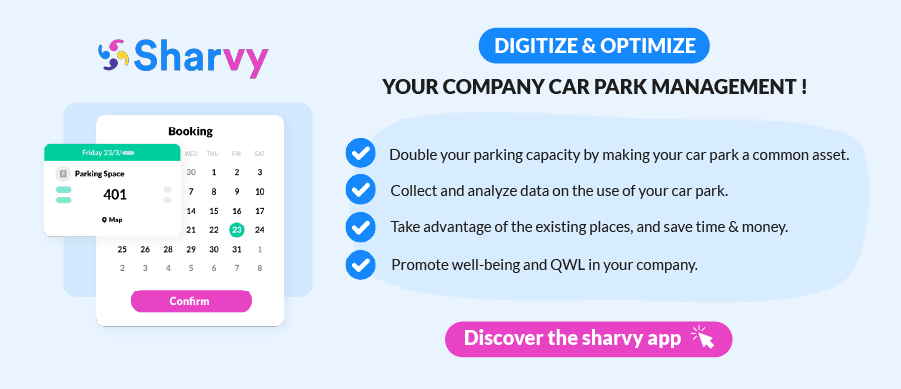
By automating reservations, employees can book a space in just a few clicks, while the system automatically manages priorities, internal rules and exceptions, without any human intervention.
Spaces are no longer fixed or nominal by default: they are allocated and released based on real needs. Absences are detected and vacant spaces redistributed, maximising the use of the company car park.
From a security perspective, modern tools such as ANPR systems, IoT modules and badges synchronised with reservations ensure that only authorised employees can access the car park, making control reliable.
At the same time, real-time monitoring provides accurate data on occupancy, usage peaks and space turnover, enabling organisations to anticipate needs and justify decisions to management.
Ultimately, such a solution significantly improves the employee experience: bookings become simple and transparent, the sense of fairness increases, and frustrations disappear.
In conclusion
When these tell-tale signs start to appear, it becomes clear that a manual system has reached its limits. Moving to an intelligent, automated solution isn’t just about modernising a tool — it’s about simplifying daily operations, optimising available space, and enhancing employee satisfaction.
By adopting a management approach based on reliable data, effective access control, and transparent rules, the car park stops being a problem and becomes a genuine driver of performance and workplace wellbeing.
Any questions? Check out the following FAQ!
Is it difficult to train employees to use this type of solution?
Not at all. The interfaces are generally intuitive and accessible from a smartphone or computer, even for the least tech-savvy users. Most have clear interfaces and simple dashboards, allowing you to book a slot in just a few clicks. Automatic notifications remind you of your booked slots and alert you in case of changes, which significantly reduces the risk of error.
Does installing the system require major work?
Not necessarily. Many devices, such as ANPR cameras, IoT modules, and badges, can be installed quickly and connected to existing systems. Deployment is generally gradual and can be scaled according to the company’s needs.
Want to learn more? Check out our latest articles to stay up to date!
The checklist for choosing car park reservation software!
How do you choose car park reservation software for your business? What features should you choose? The answers are right here.
Disabled parking space: how can you make sure it’s respected in your company car park?
Why and how can you ensure the availability of a disabled parking space in your company car park? Discover practical advice and solutions.
Company car park: what are the differences with & without a digital solution?
Why opt for a digital solution for your company car park? What are the benefits compared with traditional methods? Focus!
Subscribe to our newsletter!
PARKING & WORKPLACE MANAGEMENT SOLUTION
Car park management - Charging points monitoring - Desk booking - Booking by time slots



LABELS & COMMUNITIES




SUBSCRIBE TO THE NEWSLETTER
Receive the latest Parking & Workplace trends by email once a month.

