
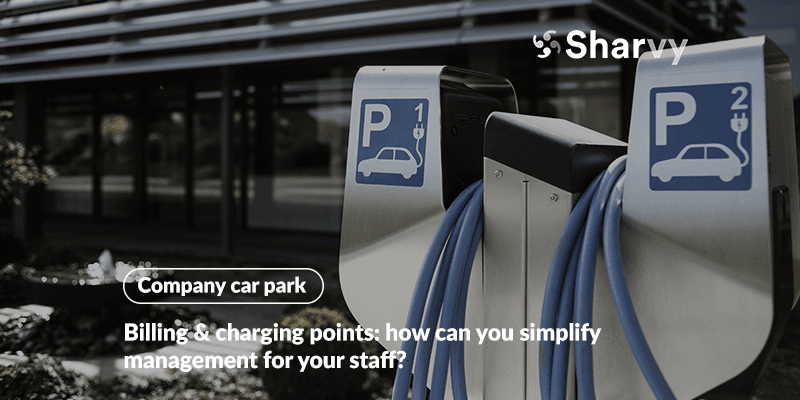
Have you installed charging points in your company car park? That’s an excellent first step towards supporting the transition to electric mobility. But one question often arises when it’s already too late: how are you going to manage their day-to-day use?
And yes: behind a charging point lies a reality that’s more complex than it seems.
One employee charges their personal vehicle, another uses a company car, and a visitor plugs in from time to time. But who should pay? At what rate? How do you track usage? And above all, how do you prevent these issues from turning into a never-ending series of Excel spreadsheets, manual checks and time-consuming back-and-forth?
As electric vehicles become more widespread, charging points are becoming a genuine service offered to staff. They must therefore be as simple to use as they are to manage.
In this article, discover the main challenges associated with invoicing for company charging points, the mistakes to avoid, and the solutions that can automate their management to provide a smoother experience for both employees and site managers. Focus.
Why is charging station billing becoming an issue for businesses?
With the rise of electric and plug-in hybrid vehicles, charging points are gradually becoming an essential piece of equipment for businesses. This trend is also driven by regulations that encourage – and in some cases even mandate – the roll-out of charging infrastructure in company car parks.
However, whilst this development is a boon for mobility and quality of life at work, it also adds complexity to day-to-day management. Not all users have the same rights or the same access conditions: some benefit from free charging, others must be charged according to their usage, whilst some companies choose to cover part of the costs.
Each situation may require a different approach. Without a suitable solution, the teams responsible for facilities management and mobility must juggle various pieces of information: who used a charging point, when, for how long, and how much energy was consumed. This data is essential for accurate billing, but collecting and processing it can quickly become time-consuming when done manually.
Moreover, the challenge is not limited to billing. Companies also need to monitor the use of their infrastructure to ensure that charging points are sufficiently available, to identify any misuse, and to better anticipate their energy expenditure. Having a clear overview of consumption per user or per charging point therefore becomes a key tool for effectively managing their charging fleet.

The various billing methods available.
Once the charging points have been installed, the company must define a clear charging policy. Should it offer this service free of charge? Ask staff to contribute? Bill only for certain types of usage?
There is no single correct answer: the choice depends on the company’s business model, the profile of its users and its objectives (employee benefit, cost control, infrastructure optimisation, etc).
1. Free charging: a benefit offered to staff.
Some companies choose to cover the full cost of charging. This approach can be a real asset in terms of employer branding, particularly at a time when more and more employees are switching to electric vehicles.
Offering this service free of charge also simplifies administration: the company does not need to calculate individual consumption or set up a billing system.
However, this solution can quickly reach its limits as the number of users increases. Without accurate monitoring, it is difficult for the company to measure its energy expenditure, allocate usage fairly or prevent a charging point from being monopolised for too long by a single vehicle.
2. Billing based on actual consumption (per kWh).
Billing per kilowatt-hour consumed is now one of the most widely used methods. Each charge is linked to a user and billed according to the amount of energy actually consumed.
This approach is seen as fairer: everyone pays only for what they use. It also enables the company to better control its costs by providing an accurate picture of consumption.
However, to work effectively, this method requires a system capable of automatically identifying users, measuring consumption and generating the data needed for billing.
With Sharvy, companies can simplify this management by combining the booking of parking spaces and the use of charging points within a single app. An employee can therefore book a space equipped with a charging point via the app, in accordance with the rules set by the company (priority access, maximum duration, available time slots, etc).
Once charging is complete, the information relating to the session is automatically linked to the correct user: charging duration, energy consumption, usage history, etc. This gives the teams in charge of the car park a clear overview of usage and enables them to apply their billing policy more easily, without having to carry out manual monitoring.
3. The monthly flat rate: a simpler solution to administer.
Some companies prefer to introduce a fixed monthly flat rate for staff who regularly use the charging points. The principle is simple: the user pays a pre-defined amount, regardless of their exact level of consumption.
This solution simplifies administrative management and provides greater transparency for both staff and the company. However, it may be less accurate as it does not necessarily reflect each user’s actual usage.
4. Partial coverage of charging costs.
Another model involves sharing the costs between the company and the employee. For example, the company may cover part of the charging costs as part of an employee benefit, whilst the employee pays the remainder.
This approach strikes a balance between supporting the transition to electric vehicles and maintaining budgetary control. It does, however, require a clear definition of the applicable rules: which users are covered? What proportion is covered? How is consumption tracked?
Ultimately, whichever model is chosen, the main challenge remains the same: having reliable data to apply the correct billing rules. Without the right tools, management can quickly become complex, particularly when multiple user profiles and different cost-sharing arrangements coexist.
How can the entire management of corporate charging be automated?
1. Centralise usage data on a single platform.
When information relating to charging points is scattered across different tools and files, managing it quickly becomes time-consuming. A centralised platform allows you to view users, bookings, usage and associated costs all in one place. This gives teams a clear overview of infrastructure usage, without having to carry out multiple manual checks.
2. Integrate charging point management with car park management.
A charging point is never standalone: it is always linked to a parking space. It therefore makes sense to manage these two elements together. By combining parking and charging, staff can book a space equipped with a charging point directly, and the company can even monitor the occupancy of its spaces.
This management is entirely possible thanks to the Sharvy app. Employees book their spaces, access the available services, and administrative teams can easily monitor usage.
3. Automate billing rules.
Using a dedicated solution, the company can apply different rates depending on the user’s profile, distinguish between private and company vehicles, and set a consumption limit.
Once these rules are configured, charging data is automatically linked to the correct user: number of sessions, charging duration, amount of energy consumed and associated cost. The company therefore no longer needs to collect information manually, check each usage instance or recalculate the amounts to be invoiced.
4. Reducing administrative tasks.
Automating the management of charging points primarily simplifies the day-to-day work of the teams responsible for monitoring them. Without a dedicated solution, information is often scattered across manual records, Excel files and communications with staff to identify consumption and verify usage.
By using an app such as Sharvy, charging data is collected automatically: the company knows who the users are, the sessions carried out, the associated consumption and the corresponding costs. Rules defined in advance are applied automatically, which minimises the need for manual intervention and reduces the risk of errors.
So, why combine car park management with charging point management?
Charging points and parking spaces are two inseparable elements: a charging point is only useful if the associated parking space is available at the right time. Yet, in many companies, these two areas are still managed separately, which can quickly lead to day-to-day difficulties.
By combining these two areas, the company simplifies both:
↪ The employee experience: staff can book a space equipped with a charging point directly, in accordance with the rules set by the company, without having to use multiple tools or take any extra steps. This means they know in advance that a suitable space is waiting for them and can organise their journeys more easily.
↪ The use of infrastructure: for example, by preventing a charging-point-equipped space from being reserved by a vehicle that does not need charging. The company thus optimises the use of its existing equipment and ensures better access to charging points for staff who genuinely need them.
↪ Monitoring and managing usage: by consolidating data relating to parking and charging, teams gain a more comprehensive overview of their infrastructure: occupancy rates of charging bays, frequency of charging point use, and employees’ actual consumption and needs. This information makes it easier to adjust mobility policy and future investments.
Thanks to Sharvy, businesses have a single solution for managing both their car parks and their charging points. Operational management is simplified whilst offering a smoother experience for staff: a single tool for booking, accessing available services and tracking equipment usage.
In conclusion
Billing for company charging points must not become a barrier to the development of electric mobility. Whilst employees expect, above all, a simple and accessible service, companies, for their part, need to maintain clear control over usage and associated costs. The real challenge, therefore, is to strike the right balance between ease of use and effective management to smoothly support the evolution of new mobility practices within the workplace.
Any questions? Check out the following FAQ!
Is it compulsory to charge employees for charging electric vehicles at work?
No, a company is not obliged to charge its employees for charging. It may choose to offer this service free of charge, introduce a contribution scheme, or charge according to actual consumption. The choice depends on its mobility policy, its objectives and the number of users involved.
How can you prevent a charging point from being monopolised by a single vehicle?
Establishing rules for use helps to organise access to charging points more effectively: compulsory booking, maximum parking time, priority based on needs, or monitoring of usage. This ensures a fairer use of the available infrastructure.
Fancy finding out more? Check out our latest articles to stay up to date!

Future of work : what trends and technologies lie behind this notion?
Between utopia and dystopia, what can managers expect and how can they prepare for the “Future of work” ? The answers here!

Work environment : 10 golden rules for improving it!
Discover 10 golden rules for improving your employees’ work environment, enhancing their well-being & their QWL.

How to encourage employees to adopt sustainable mobility?
In this article, discover 6 ideas to improve your CSR policy and encourage your employees to take an interest in sustainable mobility!
PARKING & WORKPLACE MANAGEMENT SOLUTION
Car park management - Charging points monitoring - Desk booking - Booking by time slots



LABELS & COMMUNITIES




SUBSCRIBE TO THE NEWSLETTER
Receive the latest Parking & Workplace trends by email once a month.

