
Company car parks are undergoing a transformation. Long seen simply as a place to park, they are now emerging as a true hub of mobility, at the crossroads of environmental, technological and human challenges.
At the same time, the rise of electric vehicles is transforming how they are used: spaces are no longer just for parking; they must also allow for charging. Consequently, needs are evolving, and with them, the complexity of management. Reservations, access priorities, consumption monitoring, maintenance, etc.
The company car park is becoming an ecosystem in its own right.
Yet, in many companies, this transformation (still) relies on a patchwork of tools, spreadsheets and processes that are poorly connected. So, how can we regain control and turn this complexity into an opportunity? That is what we will explore in this article.
The context: increasingly complex corporate car park management.
↪ A growing variety of uses in the company car park.
Company car parks are no longer designed for a single purpose. Today, they must adapt to a wide variety of needs: employees who are only present a few days a week, passing visitors, service vehicles and electric fleets.
Added to this is the coexistence of traditional parking spaces and electric charging points. Not all spaces are equal: some must be reserved for charging, whilst others need to be optimised to maximise car park occupancy rates. This evolution demands a more refined, dynamic management approach, a far cry from the static model of the past.
↪ Separate tools for managing company car parks and electric charging points.
In many organisations, the management of company car parks and electric charging points still relies on separate systems.
On the one hand, there are tools (sometimes rudimentary) for reserving a parking space. On the other, there are specific interfaces for controlling the charging points. And in between: spreadsheets, email exchanges and manual interventions to bridge the gap.
This fragmentation complicates everything:
- Teams waste time juggling between multiple platforms.
- Data is not centralised.
- Errors and conflicts of use are on the rise.
Ultimately, management becomes more cumbersome and, above all, less efficient.
↪ Increasingly stringent technical and regulatory constraints.
The integration of electric charging points in a company car park is not limited to their installation. It also involves addressing specific technical and regulatory challenges.
In particular, it is necessary to:
- Comply with standards relating to charging infrastructure (IRVE).
- Manage the available electrical power to prevent overloads.
- Accurately track consumption (duration, kWh, user, etc.).
- Set up billing systems (for employees and potential visitors).
Without the right tool, these challenges can quickly become difficult to manage.
The limitations of traditional management of company car parks and electric charging points.
↪ A lack of visibility across the entire company car park.
In traditional management, the main sticking point remains the lack of visibility. When tools are scattered across spreadsheets, partial booking systems and dedicated EV charging point interfaces, it becomes extremely difficult to obtain a reliable, real-time overview of the company car park.
In practical terms, managers are flying blind. They do not know precisely which parking spaces are actually occupied (nor whether some are reserved but unoccupied = no-shows), which electric charging points are available or in use, nor how usage patterns evolve throughout the day or week. This lack of data creates a constant disconnect between the reality on the ground and the perception of it.
The result: spaces may remain unused whilst other users are looking to park, electric charging points may be monopolised for longer than necessary, and decisions regarding layout and investment are (often) based on intuition rather than concrete data.
To manage a company car park effectively, however, certain key performance indicators (KPIs) are essential. For example:
- The space occupancy rate (to identify under-utilisation and overcrowding).
- The usage rate of electric charging points (charging time vs. idle time).
- Vehicle turnover rate (over a given period).
- The no-show rate (spaces reserved but not used).
- Real-time availability rate (of parking spaces and charging points).
Without access to these metrics, it becomes very difficult to optimise the company car park on a day-to-day basis, and even more so to anticipate future needs, such as adding new electric charging points or reallocating spaces. We remain in a reactive mode, whereas a data-driven approach would allow for a much more strategic approach.
↪ A poor user experience.
When the management of corporate car parks and electric charging points is fragmented, the impact is immediately felt by users, whether they are employees or visitors. The experience can sometimes become a source of daily stress.
Booking a parking space or an electric charging point then becomes a complex process: multiple tools, unclear rules, a lack of visibility regarding availability… and often no certainty that the resource will actually be available upon arrival. This uncertainty causes frustration and forces users to
« constantly adapt » rather than benefit from a simple and reliable service.Conflicts over usage also become more frequent: charging points occupied for longer than expected, reserved spaces that are unavailable, or misunderstandings about priorities. Ultimately, some users end up circumventing the system, arriving earlier than necessary, or simply giving up on using the charging points.
This deterioration in the user experience highlights just how much non-centralised management of company car parks hinders the smooth running and adoption of the infrastructure put in place.
↪ Time-consuming management for site managers.
For facilities teams, managing company car parks and electric charging points quickly becomes a significant source of mental and operational strain. Between the various tools to check, booking requests to process, last-minute adjustments and incident management, teams spend a great deal of time
« keeping the system running » rather than optimising it.Every day brings its own set of micro-decisions: mediating between several users for a parking space, managing a dispute over the use of an electric charging point, responding to an urgent request or correcting a booking error. Taken in isolation, these issues seem minor, but their repetition makes management particularly time-consuming.
Without centralisation, teams remain essentially reactive. They intervene as and when issues arise, without any real ability to anticipate or structure the organisation of the company car park in the long term. The result: a great deal of energy is spent resolving irritants that could be avoided.
So, how can car park and electric charging point management be centralised?
Centralisation starts with adopting a single platform capable of bringing together all aspects of company car park management: booking and fair allocation of spaces, management of electric charging points, access rules, and real-time monitoring. The aim is simple: to replace the proliferation of scattered tools and processes with a single control point.
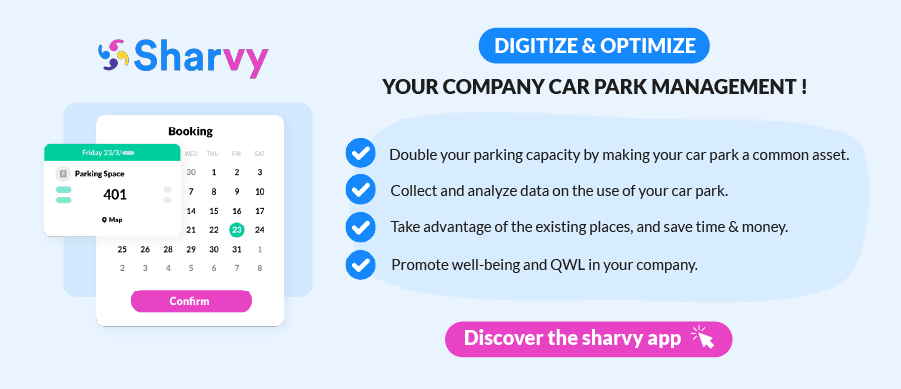
This is precisely what Sharvy offers. The solution enables companies to digitise and centralise the management of their corporate car parks, whilst natively integrating electric charging points. From a single interface, managers can configure allocation rules, automate booking allocations and monitor occupancy in real time, without having to juggle multiple systems.
For users, Sharvy radically simplifies the experience: they can book their parking space or electric charging point in just a few clicks, view availability instantly and enjoy a seamless journey, from access control to parking and charging their vehicle.
By centralising the management of corporate car parks and electric charging points in this way, Sharvy transforms a complex system into a simple tool. The company gains operational efficiency, users enjoy greater convenience, and all resources are continuously optimised.
The benefits of this centralised management of corporate car parks and charging points.
↪ For businesses: well-being, transition and operational efficiency.
For companies, centralising the management of corporate car parks and electric charging points is not merely an organisational gain: it has a direct impact on employees’ daily lives and on the overall mobility strategy.
Firstly, it makes a significant contribution to improving quality of life at work (QLW). A smooth-flowing and easily accessible car park eliminates an often underestimated source of stress: the search for a parking space or the uncertainty associated with charging an electric vehicle.
Secondly, this centralisation is fully in line with a more ambitious CSR policy. By optimising the use of parking spaces and electric charging points, the company reduces emissions associated with the search for parking spaces and encourages the use of electric vehicles. The car park thus becomes a concrete lever for ecological transition, rather than simply a logistical space.
Finally, the management of charging points is greatly simplified. Monitoring of charging sessions, access to charging points and the allocation of usage (user, kWh, energy supplied, etc.) are better organised, offering overall optimisation of costs and resources.
↪ For commercial co-ownerships & landlords: enhanced value & simplified management.
Firstly, centralisation enhances the value of property assets. A modern, digitalised car park capable of effectively integrating electric charging points becomes a genuine point of differentiation. This boosts the appeal of buildings, whether for tenant/owner businesses or prospective buyers.
It also ensures a fairer distribution of usage. Thanks to clear, automated rules, parking spaces and electric charging points are shared more equitably among users, thereby reducing tensions and misunderstandings within the car park.
Finally, it significantly simplifies management for property managers and landlords. Fewer manual interventions, fewer disputes to resolve, and a comprehensive overview of car park occupancy help reduce the administrative burden whilst improving service quality. The car park thus becomes easier to manage, whilst better meeting the expectations of its users.

In conclusion
The management of corporate car parks and electric charging points has entered a new era. With the rise of electric vehicles, the diversity of usage patterns and growing user expectations, organisations can no longer make do with fragmented solutions or manual processes. The need for centralisation is no longer an option, but a necessity.
By bringing all uses together on a single platform, companies and managers gain greater visibility, efficiency and peace of mind. Company car parks become more efficient, electric charging points are better utilised, and decisions are finally based on reliable data.
This is the philosophy behind Sharvy. More than just a tool, Sharvy transforms corporate parking into a truly smart service, aligned with the challenges of sustainable mobility, operational performance and quality of life at work.
In other words, a new way of managing car parks: simpler and more efficient.
Got a question? Check out the following FAQ!
When should a company consider centralising its car park management?
As soon as management starts to involve multiple types of users (staff, occasional visitors, electric charging points), or when requests can no longer be managed effectively by hand. Another clear sign is the proliferation of tools, such as spreadsheets, to track access and charging.
Does centralising company car park management require replacing the entire existing system?
No, not necessarily. A solution like Sharvy integrates with the existing system (HRIS, access control, etc.) by digitising and structuring management rules. The aim is not to turn everything upside down, but to streamline and then automate what is already in place.
Is a solution like Sharvy useful even for small car parks?
Yes, because even a medium-sized car park can cause friction as soon as it is shared between multiple uses. Above all, Sharvy brings clarity and simplicity, regardless of the number of spaces or electric charging points.
Want to find out more? Check out our latest articles to stay up to date!
How can your inter-company restaurant adapt to teleworking?
Teleworking : how can you manage the number of people using your inter-company restaurant & adapt your offer to new working habits? Focus.

Change management : how to facilitate the adoption of a new tool?
What are the essential steps to facilitate change management in your company ? Our advice and best practices can be found here.

Commute from home to work : a change in trends to consider ?
Commute from home to work : what trends can be observed? What are the risks? How can they be improved? Focus in this article.