
In the vast world of CSR, we often talk about waste reduction, green energy and sustainable mobility. But who thinks about the company car park?
And yet, this seemingly mundane space can become an unexpected lever for reducing your carbon footprint. Every minute your employees spend looking for a parking space generates not only stress, but also unnecessary CO₂ emissions.
Digitising your car park isn’t just about convenience: it’s a concrete step that combines innovation, efficiency and environmental responsibility. In this article, we show you why transforming your car parks into smart spaces is far more than just a technological gimmick: it’s a genuine CSR initiative with a significant carbon impact. Let’s take a closer look!
The environmental impact of traditional company car parks.
1. Land consumption and land sealing.
Very often, company car parks occupy vast impermeable areas, usually concrete or tarmac, which contributes to several environmental issues;
On the one hand, land sealing. The conversion of green and natural spaces into car parks reduces the soil’s ability to absorb water, increasing the risk of flooding and, unfortunately, the loss of local biodiversity.
Secondly, the proliferation of urban heat islands. Large asphalted areas absorb heat and raise ambient temperatures, leading to excessive energy consumption for cooling surrounding buildings.
At the same time, there is a visual and urban planning impact. A traditional car park creates an unattractive landscape and encourages urban sprawl, limiting the energy efficiency of the surrounding areas.
2. Indirect emissions linked to traffic.
Car parks also generate CO₂ emissions indirectly:
-
- Searching for spaces: every car circling in search of a space wastes fuel. According to some studies, up to 30% of urban traffic is linked to this search.
-
- Air and noise pollution: more traffic means more greenhouse gas emissions, as well as noise, impacting the quality of life of employees and local residents.
-
- Cumulative effect: over a whole year, a poorly organised car park can result in several tonnes of CO₂ being emitted unnecessarily.
3. Energy consumption by infrastructure.
Beyond their impact on urban planning, traditional car parks also involve significant energy consumption.
Their operation relies on various pieces of equipment that often run continuously, without any real optimisation. Lighting, for example, frequently remains on all the time in underground or outdoor car parks, even when the areas are barely used or completely empty.
Added to this are security and access control systems: surveillance cameras, automatic barriers and payment terminals, which consume electricity continuously.
Finally, the maintenance of this infrastructure, when not managed or optimised, can lead to inefficient use of resources and generate additional energy consumption.
The digitalisation of corporate car parks: principles and technologies.
The digitalisation of a car park is based on a simple principle: using technology to better understand and optimise its use.
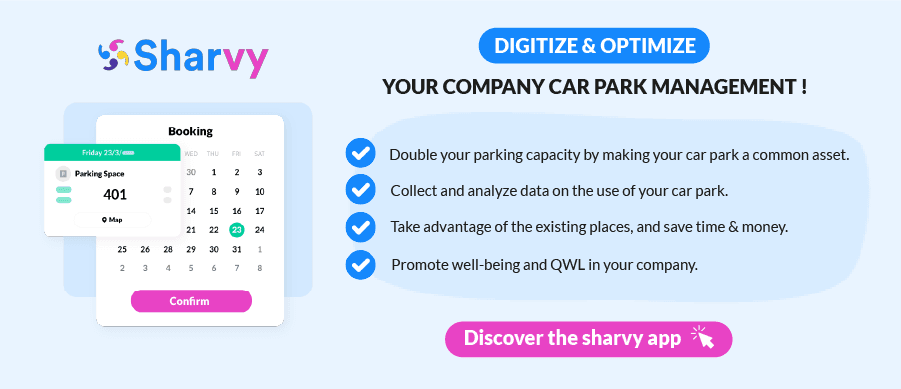
Solutions such as Sharvy enable companies to manage their parking spaces in a much smoother and more organised manner. In practical terms, employees can reserve a space in advance via the app, based on the days they are in the office. This avoids situations where some people spend a long time looking for a space whilst others remain unoccupied. The company car park is thus used more fairly and efficiently.
This digital management also makes it easier to organise priorities and usage. For example, the company can allocate certain spaces to carpooling, visitors and electric vehicles, whilst maintaining a clear overview of car park occupancy. Rules are defined in advance and managed automatically, which simplifies life for both teams and managers!
Another key benefit is visibility into usage and space availability. Thanks to solutions like Sharvy, employees know in advance whether parking spaces are still available on the day they come into the office. This simple information can have a real impact on travel choices. For example, if no car spaces are available, some may decide to opt for an alternative mode of transport, such as cycling, using public transport or carpooling.
This transparency thus helps to encourage more sustainable behaviour, without imposing any constraints. Employees naturally adapt their mode of transport according to availability and their habits. For the company, it is also a practical way of encouraging a variety of travel options whilst optimising the use of its infrastructure.
The company car park then becomes a real tool to support the transition towards more responsible travel.
The CSR benefits of digitising company car parks.
1. A reduction in emissions linked to commuting.
The search for a parking space now accounts for a significant proportion of traffic. According to several studies carried out by major cities, up to 30% of urban traffic is generated by drivers looking for a space, leading to unnecessary fuel consumption and CO₂ emissions.
Robert Giliotti (Director of TaM Parking in Montpellier) points out that in some cases, motorists can spend up to 20 minutes looking for a space, which increases congestion and local pollution.
By digitising car park management and enabling staff to check in advance whether a space is available or to reserve one, the company reduces these unnecessary journeys.
A recent study has also shown that smart parking solutions can reduce the time spent searching for a space by up to 43% and cut the distance travelled by 30%, directly contributing to the reduction of greenhouse gas emissions.
2. Encouraging more sustainable mobility.
The digitalisation of car parks can also play a key role in the transition towards more sustainable mobility. By providing visibility on space availability, employees can adapt their mode of transport according to what is available.
For example, if no car parking spaces are available on a given day, some may choose to cycle, use public transport or carpool. This type of mechanism naturally encourages a diversification of transport options, without imposing any direct constraints.
This development is all the more significant given that 75% of French people (still) use their private cars for their commutes, which highlights the potential for transforming corporate mobility policies.
Digital car park management also allows certain spaces to be reserved for carpooling or electric vehicles, thereby facilitating the implementation of a sustainable mobility strategy aligned with the company’s CSR objectives.
3. An improvement in the employee experience and well-being.
CSR is not just about the environment: it also encompasses quality of life at work. Yet the issue of parking can be a daily source of stress for employees.
A study conducted by Sharvy reveals that 36% of workers say they are regularly late for work because of the search for a parking space, and that they spend on average up to 30 minutes a week looking for a parking space.
This situation has a direct impact on employees’ well-being. Arriving at the office after driving round a car park or the surrounding streets for several minutes can lead to frustration, fatigue and wasted time. In certain business districts, such as La Défense, the average time spent looking for a space can reach 20 minutes, which can result in nearly 750g of CO₂ emissions for a single search and contributes to a particularly stressful journey.
More broadly, parking is identified as a source of stress for many motorists: a recent survey indicates, for example, that 67% of drivers consider looking for a parking space to be a stressful situation.
By making it easier to find parking through digital solutions such as Sharvy, companies can reduce this daily stress. Employees know in advance whether a space will be available or can reserve one based on their presence in the office.
This simple change improves the predictability of the commute, reduces delays and contributes to a more relaxed employee experience right from the start of the day.

4. More effective management of the company’s mobility strategy.
Finally, the digitalisation of car parks enables companies to better understand the actual usage of their facilities. Occupancy data often shows that car parks are underutilised: some have an average occupancy rate of only around 70%, despite the impression that they are always full.
This phenomenon is often due to the allocation of fixed parking spaces to certain employees, which sometimes remain empty when they are not present. Thanks to solutions such as Sharvy, the company can optimise this management and allocate available spaces more effectively.
This data-driven approach enables more informed decisions to be made: adjusting the number of spaces, encouraging certain modes of transport, or adapting the parking policy. The company car park then becomes a real lever for managing mobility and reducing the company’s carbon footprint.
In conclusion
What if you looked at your company car park in a different light? This simple parking space can become a real driver for your CSR strategy. By digitising it, you don’t just save time and improve traffic flow: you tangibly reduce CO₂ emissions, encourage more sustainable travel and improve your employees’ daily lives. Every optimised space is a small gesture for the planet, and every journey avoided counts.
So why continue to view your car park as just a place to park?
Any questions? Check out the FAQ below!
Is digitalisation suitable for businesses of all sizes?
Yes, absolutely. Solutions like Sharvy are fully scalable and can be tailored to the size and needs of every business. For large companies with multiple car parks and hundreds of spaces, they enable centralised management, real-time monitoring of occupancy, and prioritisation of certain uses, such as carpooling, visitors or electric vehicles.
For SMEs or smaller organisations, these tools offer a simple and effective solution to optimise a limited number of spaces, avoid conflicts over usage and improve the employee experience. Even with a modest car park, digitalisation helps improve visibility, better plan attendance and encourage more sustainable behaviour.
Ultimately, whether your company manages 10 or 1,000 spaces, digitalisation adapts to your needs and can have a tangible impact on efficiency, mobility and CSR, without technical complexity or disproportionate investment.
Can digitising company car parks improve the quality of life at work?
Absolutely. By making booking easier and providing visibility on space availability, digitalisation allows employees to arrive at the office with greater peace of mind, without having to drive around for several minutes looking for a parking space.
This time saving also reduces daily stress and improves punctuality. Beyond individual comfort, this translates into better concentration from the start of the day and increased productivity. Employees thus feel better looked after by the company, which helps to boost their satisfaction and commitment.
Want to find out more? Check out our latest articles to stay up to date!

How can your inter-company restaurant adapt to teleworking?
Teleworking : how can you manage the number of people using your inter-company restaurant & adapt your offer to new working habits? Focus.

Change management : how to facilitate the adoption of a new tool?
What are the essential steps to facilitate change management in your company ? Our advice and best practices can be found here.
Commute from home to work : a change in trends to consider ?
Commute from home to work : what trends can be observed? What are the risks? How can they be improved? Focus in this article.
Subscribe to our newsletter!
PARKING & WORKPLACE MANAGEMENT SOLUTION
Car park management - Charging points monitoring - Desk booking - Booking by time slots



LABELS & COMMUNITIES




SUBSCRIBE TO THE NEWSLETTER
Receive the latest Parking & Workplace trends by email once a month.

