
For years, company parking spaces were seen as a given perk: convenient for employees, easy to manage for general services, and a status symbol in some organisations. This model was based on one obvious fact: employees were present on site every day at the same time.
But this model no longer exists.
With the rise of teleworking and flex office, travel habits have changed profoundly. Offices are no longer occupied continuously; some days see the majority of employees present, while others leave the car park half empty. Yet parking spaces remain reserved, fixed and inaccessible to those who might need them from time to time.
The question now arises: is the model of allocated parking spaces still relevant in the era of teleworking? This article takes a closer look.
Designated staff parking spaces: a look back at a model from another era.
Originally, employees came to the office every day, often at the same times, and companies operated according to well-established patterns. In this context, the fixed allocation of spaces responded to several realities:
- Daily and continuous presence on site,
- Consistent working hours with little variation,
- A marked hierarchy, where the parking space could also symbolise status.
The model made sense at the time. Everyone knew where to park, without stress or uncertainty. For the company, management was simple, almost automatic: one space, one employee, no decisions to be made on a daily basis.
But this system is based on an assumption that no longer holds true: that everyone is present at the same time, every day.
However, with teleworking in particular, this assumption is completely outdated. Nevertheless, parking spaces remain reserved and empty three-quarters of the time, while some employees still struggle to find a place to park.
Consequently, this parking model is no longer suited to modern office practices.
Remote working and hybridisation: the end of continuous on-site presence?
In 2026, hybrid working is no longer an experiment. It has become the standard model for many companies. A recent study conducted by MARCO highlights that more than 74% of employees believe that flexibility now defines the future of work.
Employees no longer come to the office every day: on average, they are present two to three days a week, depending on their teams and projects.
In this context, allocated parking spaces are quickly reaching their limits:
- Many remain unoccupied most of the time, even though they are reserved for a specific employee.
- Paradoxically, on some days the car park is full to capacity, when the total capacity could be sufficient if the spaces were better managed.
The problem is therefore not the number of spaces available, but their poor allocation in the face of hybrid and fluctuating usage patterns.
Maintaining a rigid system of allocated parking spaces is not only inefficient, but also creates frustration for employees and unnecessary costs for the company.
The real question is no longer « how many allocated spaces can we provide? » , but: « how can we optimise the use of parking spaces so that they meet the actual needs of each day? ».
The limitations of designated staff parking spaces.
On paper, allocated parking spaces are reassuring. In reality, they quickly become a hindrance to efficiency and the employee experience.
- Chronic under-use: With teleworking and flexible working hours, many allocated parking spaces remain empty several days a week. These spaces, although reserved, are of no use to anyone. Valuable space is thus wasted, when it could be used by other employees and visitors.
- Feeling of injustice: Nothing is more frustrating for an employee than looking for a free space while other spaces, despite being reserved, remain empty. Allocated parking spaces can thus create a feeling of inequality, damaging the employee experience and the perception of fairness within the company.
- Lack of flexibility: A 100% allocated parking system does not allow for easy management of visitors and occasional service providers, casual employees, or even daily fluctuations in attendance. The rigidity of the model hinders adaptability and often causes stress during peak hours.
- Hidden costs and inefficiency: Not to mention that behind this rigid model lie real costs: underused square metres, sometimes unnecessary expansion or redevelopment projects, and a weakened CSR image that is not compatible with resource optimisation. By maintaining allocated parking spaces, the company is financing a service that is disconnected from real needs, without creating any added value.
Why are free parking spaces « alone » not the solution?
Faced with the limitations of allocated parking spaces, some companies are opting for free parking. The idea seems appealing: no more reservations, no more constraints, everyone parks where they want. But in practice, this model quickly reveals its own shortcomings.
Without a regulatory tool, free parking creates new problems:
- The stress of first-come-first-served parking: Employees arrive earlier than necessary, not by choice, but for fear of not finding a space. Parking becomes a daily race, a source of stress and wasted time.
- Opportunistic behaviour: Without clear rules, some people take the best spaces, while others circumvent informal practices. Ultimately, free parking creates internal tensions and a feeling of permanent disorder.
- Persistent inequalities: Contrary to popular belief, free parking is not more equitable. It favours the most available or geographically closest employees, to the detriment of others. Equal access therefore remains an illusion.
Consequently, replacing a rigid model with an anarchic one does not solve the underlying problem. The real challenge is not to do away with rules, but to make them flexible, fair and adapted to actual usage.
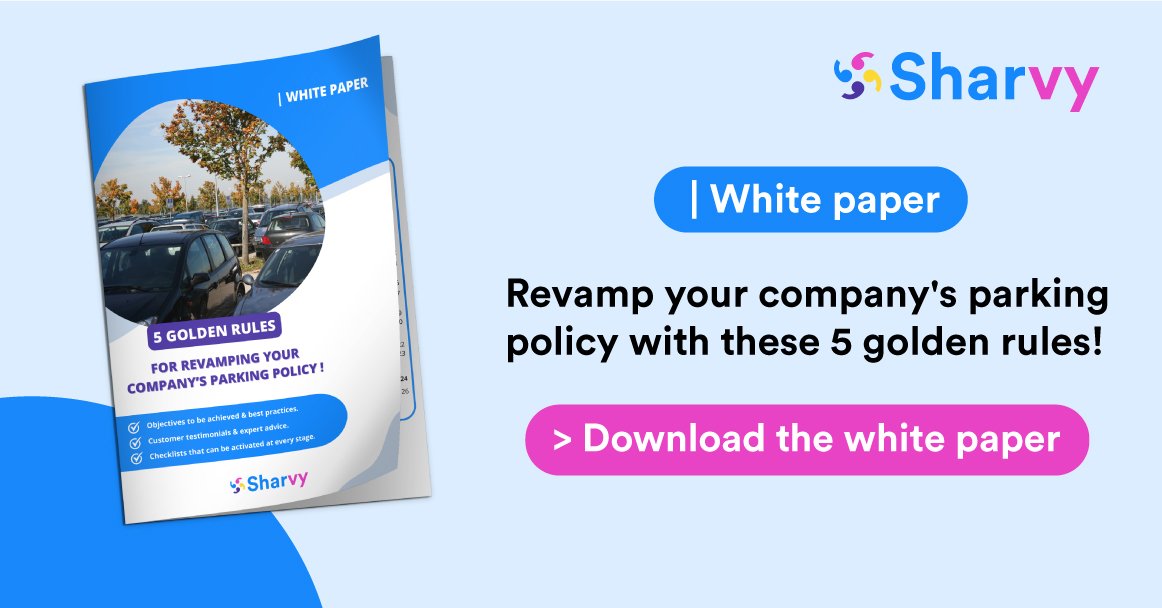
The solution? Move towards a hybrid and intelligent model of company car park management.
Rather than choosing between fixed allocated parking spaces or completely free parking, the real solution is to adopt a hybrid model that combines stability and flexibility.
In concrete terms, this means:
- A few allocated spaces, reserved for specific uses: employees with reduced mobility, members of management, teams with specific job constraints. These spaces guarantee security and predictability for those who really need them.
- A majority of spaces that can be reserved on demand, depending on the actual days of attendance of employees. Each user can reserve their space in just a few clicks, according to their schedule, needs and travel plans.
This model makes it possible to:
- Significantly increase the occupancy rate of the company car park.
- Adapt capacity to peaks and troughs in usage,
- Improve fairness of access to the car park among employees,
- And offering a better everyday experience, without stress or frustration.
By adopting this hybrid model, parking ceases to be a logistical problem and becomes a strategic tool, aligned with the real needs of the company and the satisfaction of its teams.
How does Sharvy support the transition to a “hybrid” company car park?
At the heart of the Sharvy solution is a fair algorithm: it takes into account spaces already reserved for specific uses (such as disabled parking) and automatically gives priority to employees who have obtained the fewest spaces in the last 60 days in the reservation system. This ensures fair and transparent allocation, even when demand exceeds the number of spaces available.
It should be noted that, thanks to access control, the barrier only opens if a reservation is valid, ensuring that each space is used at the right time and by the right person, eliminating abuse, overbooking and tensions related to free spaces.
At the same time, Sharvy incorporates a configurable credit system. The company can define its own rules: for example, allocating different credits according to role, frequency of attendance, priority for certain services, etc. Each employee can track their balance and manage their bookings.
Not to mention that the application is designed to be extremely user-friendly. With just a few clicks, employees can view availability, reserve their parking space and find out their entitlements based on their credits and internal policy.
For general services and HR, Sharvy offers a comprehensive, real-time view of occupancy, with detailed dashboards that allow you to anticipate peaks, optimise space, and manage the car park as a strategic asset.
Thanks to this combination, parking becomes a flexible and equitable service.
In conclusion
So, to the question: are allocated parking spaces still appropriate in the era of remote working? The answer is clear: not if the company wants to remain efficient, fair and modern. It is no longer just a question of physical space, but of employee experience.
Today, car parks must evolve with usage patterns. They must be able to adapt to absences, peaks in attendance and specific priorities, while ensuring fair access.
Ultimately, the rigid model of allocated spaces is a thing of the past. For hybrid, forward-looking companies, the solution is to think of parking as a service: intelligent and flexible, capable of anticipating needs rather than being constrained by them.
Any questions? Check out the following FAQ!
So, does teleworking completely call into question allocated parking spaces?
Not entirely. Remote working mainly changes the logic behind the allocation of spaces. Reserving all spaces permanently becomes inefficient, as many remain unused on days when employees are working remotely. The idea is not to remove all allocated spaces, but to combine stability for certain essential uses with flexibility for the majority, allowing the car park to adapt to variations in attendance while ensuring fairness.
Does a "hybrid" company car park require physical access control?
Yes, for the system to really work. In a car park of this type, access is conditional on a valid reservation. Without a reservation, the barrier will not open. This physical access control ensures that each space is used at the right time and by the right person, eliminating abuse and frustration associated with spaces being occupied by mistake.
Is this model suitable for both small and large businesses?
Absolutely. Whether the company has 50 or 5,000 employees, the principle remains the same: a few spaces reserved for specific needs, and a majority of spaces that can be reserved on demand. The system can be configured according to size and needs, offering small organisations simplicity and large companies the power of a tool that can be managed in real time.
Want to learn more? Check out our latest articles to stay up to date!
Employee experience and employer brand : the challenge of digital
The use of digital applications and services can improve the employee experience and therefore the employer brand.
Subscribe to our newsletter!
PARKING & WORKPLACE MANAGEMENT SOLUTION
Car park management - Charging points monitoring - Desk booking - Booking by time slots



LABELS & COMMUNITIES




SUBSCRIBE TO THE NEWSLETTER
Receive the latest Parking & Workplace trends by email once a month.

