
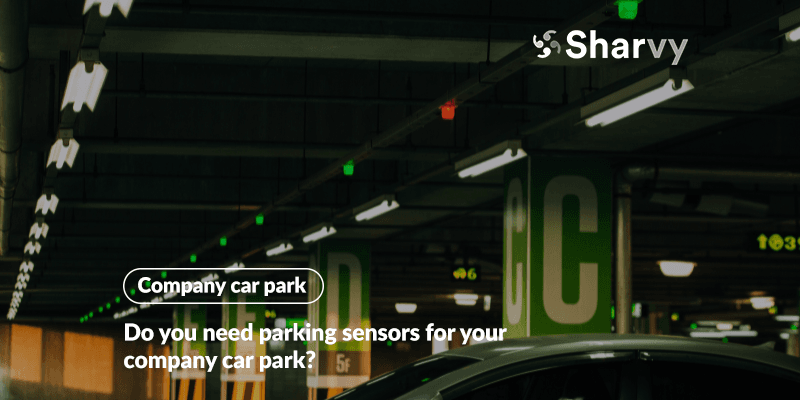
Between teleworking, flex office and shift work, company car parks have never been so complex to manage. Reserved but empty spaces, others occupied “temporarily”, visitors expected with no defined space…
The result? A perception of saturation that does not always reflect reality.
To solve this headache, more and more companies are installing parking sensors, convinced that better measurement of occupancy will be enough to solve the problem.
But is measuring really the same as managing? Parking sensors certainly make it possible to know whether a space is free or occupied, but do they meet the current challenges facing organisations: prioritisation of uses, flexibility, employee experience and overall management of the car park? This article takes a closer look.
A quick reminder: what is a parking sensor?
A parking sensor is like the electronic eye of your car park: it monitors each space and indicates in real time whether it is free or occupied. In a business context, its promise is simple (and appealing): to finally make car park occupancy visible and avoid unnecessary trips around the car park looking for a space.
Depending on your needs, it can take different forms:
- Ground-level: at each parking space (but requiring installation and maintenance).
- Aerial: to cover several spaces, easier to maintain but sometimes unreliable.
- Magnetic and ultrasonic: more discreet but not always foolproof.
These parking sensors are mainly found in covered company car parks, on large or multi-building sites, but also to manage dedicated areas such as visitor and employee spaces.
Why do companies invest in parking sensors?
Companies invest in parking sensors because they face a very common problem: how to efficiently manage a car park that is often perceived as full, when some spaces remain unused?
On paper, sensors offer a simple and attractive solution: knowing in real time which spaces are free and which are occupied, thereby reducing the time employees spend driving around looking for a space.
Beyond user comfort, they are also a strategic tool for property management and IT departments: by collecting occupancy data, they can theoretically better manage space, optimise the number of spaces required and justify future investments.
However, behind these attractive promises lies an essential question: do these sensors really meet the real needs of businesses, or do they merely provide partial information that does not solve the problems of management and flexibility in company car parks? We focus on this in the following paragraphs.
The limitations of parking sensors for your company car park.
1. Installation and maintenance costs are often underestimated.
Installing sensors is never free or simple. Between the work involved in integrating ground sensors, adjustments for aerial sensors, and the network required to centralise data, the bill can quickly add up.
And that’s not all: these devices require regular maintenance to remain reliable, not to mention the possible replacement of defective sensors, which can turn an initial investment into a recurring expense that is much higher than expected.
2. Partial and unactionable information.
Admittedly, sensors indicate whether a space is occupied or free. But that’s often all they do. They don’t say who can use that space, whether it’s prioritised for a visitor, an employee or an electric vehicle, or how to redistribute space in the event of high demand. For management, this means raw data that is difficult to use to effectively manage the company car park.
3. Rigid technology in the face of new uses.
Company car parks are no longer static: between teleworking, flex office, shift rotation and carpooling, needs are constantly changing. Sensors, on the other hand, remain fixed on their basic function: detecting the presence of a car.
As a result, they do not adapt to dynamic rules, reservations, or priorities that change from day to day, such as user profiles. The result? Technology that is sometimes overtaken by the modern uses it is supposed to facilitate.
Ultimately, parking sensors may give the impression of control, but their real effectiveness in businesses is often limited by their cost, the partiality of the information they provide, and their inflexibility in the face of contemporary needs.
Parking sensors vs. digital corporate parking management solutions.
1. The real need for businesses: knowing which space to use.
When you think about it, the real problem for businesses is not simply knowing whether a space is available, but knowing which space to use, when and by whom.
With traditional sensors, we have the answer to the first question, but not to the others: an employee may waste time looking for a space that is accessible to them, a visitor may find themselves stuck in a reserved area, and internal car park rules remain invisible.
In other words, measuring occupancy is not the same as managing space intelligently.
2. Digital solutions for corporate car park management.
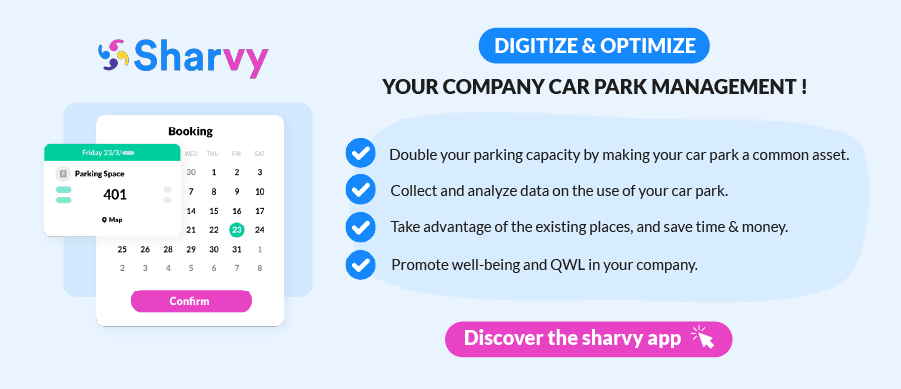
This is where digital car park management solutions come in. Solutions such as Sharvy not only allow you to see which spaces are free in real time, but also to reserve a space according to specific criteria, prioritise certain users, and view the overall occupancy of the car park from a single interface.
Employees can check which spaces are available to them from their smartphones, visitors are guided to reserved spaces, and management has actionable data to optimise space and anticipate future needs.
3. Advantages of digital solutions over parking sensors.
Compared to traditional sensors, these solutions offer clear advantages: they are flexible, scalable and user-oriented, allowing you to manage your car park strategically rather than simply observing it. They also reduce wasted space while improving the employee experience.
In short, where sensors simply detect presence, digital solutions such as Sharvy transform the car park into a smart service for employees, visitors and the company itself.
So, what strategy should you adopt for your company car park?
Before giving in to the temptation of the latest sensors or other technological gadgets, it is essential to ask yourself the right questions.
- What is the main purpose of your company car park?
- Is it simply to know whether a space is available or to optimise space?
- Who are the main users and what are their actual needs?
- How many rotations per day, one-off bookings, or special uses do you need to anticipate? Etc.
Taking the time to answer these questions will help you avoid costly investments in technologies that will only solve part of the problem.
In conclusion
Finally, remember that parking sensors are neither useless nor miraculous. They offer a partial view of occupancy and may be appealing because of their “technological” aspect, but in a modern business context, they are often insufficient and inflexible when it comes to actual usage.
Their installation and maintenance costs, their limited ability to guide users and their lack of flexibility sometimes make them an investment with a far from guaranteed return.
For businesses, the real value lies not in simply detecting cars, but in intelligent and flexible car park management. Digital solutions, such as Sharvy, make it possible to know which space to use, when and by whom, to manage space strategically and to transform the car park into a useful service for employees and visitors.
Any questions? Check out the following FAQ!
What are the main disadvantages of parking sensors for businesses?
Firstly, the cost: installation, any necessary work, maintenance and replacement of sensors can quickly put a strain on the budget. Secondly, the information they provide is partial: they simply indicate whether a space is free or occupied, without taking into account usage priorities, internal rules, or the specific needs of employees and visitors.
Finally, they are rigid technologies: they do not adapt to new uses such as teleworking, flex office and team rotations, and therefore do not allow for intelligent and dynamic car park management.
Do digital solutions completely replace parking sensors?
Not always. In some cases, sensors can complement a digital solution by providing real-time data on the physical occupancy of spaces.
But the real value comes from software and intelligent organisation: space reservation, user guidance, prioritisation according to profiles, and data exploitation to manage the car park.
In other words, digital solutions do not just replace sensors: they transform parking into an intelligent, flexible and scalable service, whereas sensors remain a simple detection technology.
Want to learn more? Check out our latest articles!
Fleet manager: the benefits of a parking management application.
How can a fleet manager improve car park management across company sites? The challenges & benefits of using a Parking Management app.

Digital Workplace : a lever for well-being at work ?
What if the Digital Workplace was more than just a set of tools? How can it simplify the lives of your employees? Find out here!
The future of company car park badge systems : integrating AI & IoT?
How are AI & IoT revolutionising badge systems for company car parks? Towards simpler, more secure and connected access.
Subscribe to our newsletter!
PARKING & WORKPLACE MANAGEMENT SOLUTION
Car park management - Charging points monitoring - Desk booking - Booking by time slots



LABELS & COMMUNITIES




SUBSCRIBE TO THE NEWSLETTER
Receive the latest Parking & Workplace trends by email once a month.

