
Installing electric charging points in the workplace has become essential with the rise of electric vehicles, as well as the new Workplace Charging Scheme. But the real issue isn’t just about installation: it’s primarily about how to deploy and manage them on a day-to-day basis.
After all, a charging point never operates in isolation. It forms part of a car park, which is sometimes shared by several businesses, with changing needs and staff who need to coordinate. Very quickly, a simple question arises: which solution should you choose : purchase, leasing or a turnkey service?
Buying allows you to retain control over the equipment, leasing offers greater financial flexibility, whilst a turnkey service goes a step further by simplifying the entire system, particularly in terms of day-to-day management and operation.
So, the task is to choose the approach best suited to your business and your car park, based on your needs, your budget and your desired level of management. We’ll take a closer look in this article.
Business needs regarding electric charging.
With the rise of electric vehicles, businesses must adapt to new usage patterns in their car parks. Charging is no longer just a perk, but a genuine factor in attracting staff and enhancing their comfort.
There are many requirements:
-
- Making day-to-day charging easier (charging during the working day).
- Dealing with limited resources (fewer spaces and charging points than there is demand).
- Avoiding tensions and imbalances in usage (monopolisation of charging points).
- Anticipating accelerating adoption (EV charging infrastructure capable of evolving over time).
In this context, the company car park is changing its status. It is no longer simply a parking space, but an environment to be managed, where value comes not only from the installed charging points, but above all from the way they are organised and used on a daily basis.

Option 1: Purchase the charging points directly.
↪ A way to control your infrastructure, but one that requires you to take on the management.
Purchasing charging points is often the first instinct for businesses. This approach involves investing directly in the infrastructure to become the owner and retain full control. However, it requires a larger initial investment than the other options, which is not limited to the equipment itself: you must also factor in installation work (electrical work, cabling, compliance upgrades), any necessary modifications to the car park, and monitoring tools if required.
This choice is generally a long-term strategy, suited to companies capable of absorbing this investment and wishing to have full control over their equipment.
But once the charging points are installed, the real challenge begins: organising their day-to-day use. This involves defining access rules (who can charge, when, and for how long), managing priorities between staff and departments, monitoring consumption, and ensuring maintenance and support in the event of an incident.
Without the right tools, this management can quickly become time-consuming and lead to friction between users.
↪ What type of business is this for?
This option is therefore particularly suited to businesses that wish to retain full control of their infrastructure, have internal resources to manage its operation, and have a car park that is relatively straightforward to organise. However, this requires the ability to manage the day-to-day operational complexity.
Option 2: Lease charging points.
↪ A way to reduce the investment, whilst retaining control.
Leasing charging points allows businesses to acquire the equipment without making a large initial investment. The principle is simple: the charging points are leased for a fixed term, with monthly payments that spread the cost over time. This approach is particularly appealing to businesses wishing to preserve their cash flow whilst progressing with their transition to electric vehicles.
Beyond the financial aspect, leasing also offers a degree of flexibility. It makes it easier to replace equipment at the end of the contract and to benefit from the latest technologies. However, this flexibility is still subject to contractual terms, involving a commitment spanning several years.
But as with purchasing, leasing does not resolve the issue of usage. Once the charging points are in place, the company must still organise their use: defining access rules, managing priorities, monitoring consumption and coordinating users. In other words, financing is simplified, but operational management remains the responsibility of the company.
↪ Which type of business is this for?
This option is particularly suited to companies wishing to limit their initial investment, benefit from greater budget visibility and roll out their infrastructure gradually. However, it requires the ability to manage the use of the charging points and any parking-related constraints internally.
Option 3: The turnkey service.
↪ A comprehensive solution, from installation to the management of charging points.
The turnkey service involves entrusting the entire project to a single service provider (e.g. the Sharvy solution): from the choice of charging points to their day-to-day management. The company no longer simply equips itself; it also delegates the operation of its charging infrastructure.
This approach generally includes the installation of the stations, their maintenance, but above all operational management: organising access, allocating usage, monitoring charging sessions and optimising the use of available spaces.
The main benefit is simple: the company no longer has to deal with the complexity. The charging points are used fairly, the rules are automated, and staff enjoy a seamless experience. Charging becomes a service integrated into the company car park, with no additional burden on internal teams.
This model is also scalable. It allows stations to be added as needs grow, usage rules to be adjusted, and usage to be tracked precisely over time, without requiring significant intervention from the company.
↪ What type of business is this for?
This model is particularly suited to companies that wish to focus on their core business without having to manage the day-to-day operation of the charging points. It is also particularly relevant for complex environments: shared car parks, high demand, and a variety of uses among staff, visitors and fleets.
Installing electric charging points in the workplace: a comparison of the three solutions.
Comparing these three approaches highlights one key point: the issue of charging points in the workplace is not merely a financial decision, but a choice regarding day-to-day organisation.
Purchasing provides control, but requires full in-house management. Leasing makes the investment easier, but does not simplify operation. As for the turnkey service, it goes a step further by incorporating not only installation, but also usage management and the optimisation of the company car park.
In practice, as soon as car parks become shared, demand increases and usage patterns become more complex, the question is no longer simply « how to equip oneself », but « how to operate the system simply and efficiently over the long term ».
It is precisely in this context that Sharvy stands out as a particularly well-suited turnkey solution. By combining charging points with smart parking space management, it enables businesses to transform a complex issue into a fair and easy-to-manage service on a day-to-day basis.
Focus: the Sharvy solution for managing your company’s electric charging points.
Beyond the choice between buying, leasing or a turnkey service, one aspect is often underestimated: the actual management of the charging points once they are installed. It is precisely in this area that Sharvy provides a concrete solution, by integrating electric charging into a comprehensive and smart management system for corporate car parks.
↪ An approach centred on the car park, not just the charging points.
In many companies, spaces are limited, sometimes shared between several teams and even several companies. In this context, charging cannot be managed. Usage must be organised, conflicts avoided and fair allocation ensured. This is exactly what the Sharvy solution enables.
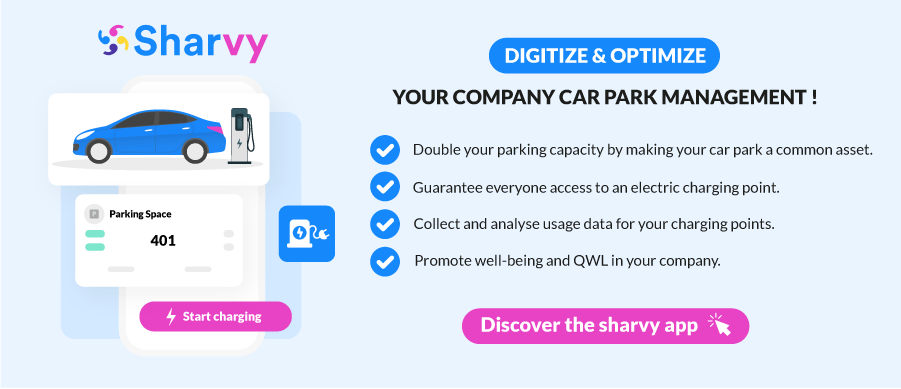
In practical terms, employees do not book a charging point directly, but a parking space equipped with a charging point. This allows charging to be integrated into the overall parking system, without creating a parallel system that is difficult to manage.
When a user books a space, they know in advance that they will be able to plug in their vehicle whilst at the office, in accordance with the rules set by the company.
Then, to prevent unfair usage (always the same users getting the best spaces), Sharvy uses a fair algorithm.
The allocation of spaces equipped with charging points is optimised by taking into account booking history over a rolling period (for example, the last 60 days). The aim is simple: to ensure a fair distribution of access over time, so that all employees can benefit from charging on an equal basis.
Finally, Sharvy allows for the application of usage rules tailored to the company’s needs: parking duration, vehicle rotation, prioritisation of certain groups (people with reduced mobility, pregnant women, etc.) and optimisation of charging point occupancy rates. The whole system operates automatically, significantly reducing the need for manual management on the company’s part.
↪ A solution to the real challenges faced by businesses.
Sharvy addresses very practical issues faced by businesses: the rapid increase in electric vehicles, car parks that are often shared or under strain, and limited charging capacity in the face of growing demand.
In this context, the priority is to simplify day-to-day management whilst ensuring the smooth use of resources. Without a suitable organisational structure, conflicts over usage can quickly arise between staff members, hence the value of a structured system that allows for better allocation and anticipation of needs.
In conclusion
The deployment of electric charging points in the workplace is not simply a matter of choosing the right equipment. Whether purchasing, leasing or opting for a turnkey service, each option follows a different logic in terms of investment, flexibility and, above all, day-to-day management.
Whilst purchasing offers greater control and leasing provides financial flexibility, both models still leave a significant degree of operational complexity for the business to manage. However, with the rise of electric vehicles and increasing pressure on car parks, it is the management of usage that is becoming the real challenge.
In this context, integrated solutions are becoming increasingly important. Players such as Sharvy enable you to go beyond simply installing charging points by combining them with smart management of parking spaces and charging.
Got a question? Check out the following FAQ!
How long does it take to install charging points at a business?
The timeframe depends on the number of stations and the complexity of the site. On average, it takes between 4 weeks and 2 months, including the technical study, installation work and commissioning.
Is it possible to charge users for charging?
Yes. Businesses can choose to make charging free, partially paid for, or fully charged to users according to a defined pricing structure. Sharvy also includes a feature dedicated to billing for parking spaces and charging points within its app.
Want to find out more? Check out our latest articles to stay up to date!

Designated staff parking spaces: is this still relevant?
Are designated staff parking spaces still relevant in the remote-working era? What are the limitations? Focus!

Do you need parking sensors for your company car park?
Are parking sensors a worthwhile investment or just a technological luxury for your company’s parking lot? Let’s take a closer look!

How Sharvy helps CIOs secure access & car park data?
Why are access security & corporate car park data a critical issue for CIOs? How can Sharvy help? Focus in this article!