
Can a company really claim to be managing its workplace if it doesn’t know what’s going on in its own premises?
Every day, dozens, sometimes hundreds, of decisions are made regarding the workplace: how many offices to retain, how many parking spaces to provide, which areas to refurbish, and what services to offer staff. Yet a large proportion of these choices are still based on estimates or habits.
The paradox is simple: companies today have increasingly smart buildings, but sometimes still lack visibility into how these spaces are actually being used.
A genuine workplace management strategy begins precisely with this question: what is actually happening in our workspaces? Because before we can optimise, we need to understand. Before we can reorganise, we need to measure. And before we invest, we need to know which uses are truly worth developing. We’ll be looking at this in more detail in this article.
A quick reminder: what is a workplace management strategy?
A workplace management strategy is not simply about managing offices, meeting rooms or car park spaces. It stems from a broader observation: a workspace only has value if it genuinely meets the needs of those who use it.
The challenge, therefore, is to understand how staff use their spaces on a day-to-day basis in order to make better decisions: should certain spaces be redesigned? Should the services on offer be adapted? Should existing resources be optimised?
In other words, workplace management involves moving away from a management approach based on habits towards a smarter approach, where every decision is based on a better understanding of the actual needs of the organisation and its staff.
Why do companies need digital tools as part of their workplace strategy?
Implementing a workplace management strategy means adapting your spaces to the actual needs of your staff. But without data, how can you know if the decisions you’re making are the right ones?
Let’s take an example: if employees struggle to find a parking space on Tuesdays, is it because there aren’t enough spaces, or because some remain reserved even though they aren’t actually being used? If an office floor seems empty, is it actually under-utilised, or are teams simply present at other times of the week?
Without a digital tool, it is difficult to answer these questions. Companies often rely on gut feeling or ad-hoc feedback, which does not always reflect reality.
Digital tools therefore enable assumptions to be replaced with facts. They provide a clear picture of how offices, car parks and other shared spaces are used, make bookings easier and highlight staff habits. This allows the company to identify what is working, what could be improved and to make more informed decisions.
In other words, a digital tool does more than simply manage spaces: it helps to understand how they are actually used, so that the workplace can be developed based on usage patterns rather than intuition.
The role of the company car park in an overall workplace management strategy.
When it comes to workplace management, car parks are often overlooked. Yet they are one of the first points of contact between an employee and their working environment. An unavailable parking space, unclear allocation rules or an overcrowded company car park can quickly spoil the experience right from the start of the day.
Conversely, a well-managed car park helps to make day-to-day life run more smoothly. Employees know in advance whether they have a space, resources are better allocated, and unoccupied spaces can be reallocated to those who need them.
Car parks also offer significant potential for optimisation. At a time when companies are seeking to make better use of their infrastructure, it is essential to know the actual occupancy rate, identify periods of high demand and adapt allocation rules accordingly.
Integrating car park management into an overall workplace management strategy is therefore not just about making parking easier. It means treating the car park as a resource in its own right, on a par with offices and meeting rooms, in order to offer employees a better experience whilst optimising existing infrastructure.
How does Sharvy fit into an overall workplace management strategy?
No single piece of software, on its own, constitutes a workplace management strategy. Tools cannot replace careful consideration of usage patterns, a clear policy, or support for change. However, they can make this strategy much easier to implement on a day-to-day basis.
This is precisely where Sharvy comes in. The solution does not seek to transform a company’s practices overnight, but rather to streamline the management of shared resources that often cause the most friction: parking spaces, workstations and charging points.
Another key benefit lies in its ability to integrate seamlessly into the company’s existing ecosystem. Rather than multiplying tools or creating parallel processes, Sharvy can be connected to various systems (HRIS, company directory, SSO, etc.) so that it fits naturally into employees’ routines.
Another important point: a workplace strategy is never set in stone. Needs evolve, teams grow, and patterns of attendance change. A solution like Sharvy therefore makes it easier to adjust booking rules, access rights and the allocation of resources, without having to overhaul the entire organisation.
Ultimately, Sharvy is not an end in itself, but a tool. Its role is to help organisations implement their workplace management strategy in a simpler, more consistent and more scalable way, whilst leaving strategic decisions in the hands of the organisation.
The benefits of a workplace management approach incorporating Sharvy.
The aim of a digital tool is not to make the workplace more complex, but rather to eliminate certain day-to-day frustrations. Of course, a single solution does not resolve all the challenges associated with new ways of working. However, it can facilitate the management of shared resources and make rules simpler to apply.
↪ For staff: a smoother day-to-day experience.
For employees, the primary benefit is often very practical: no longer having to search for a parking space or an available desk, or wonder which resources are accessible when they arrive on site.
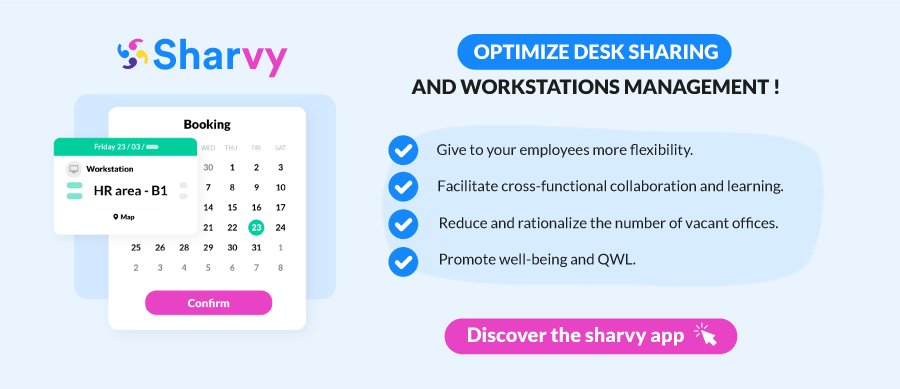
With Sharvy, for example, an employee can book a parking space via the app, cancel their booking if they decide not to come into the office after all, and check availability in real time. The same principle applies to workspaces, such as offices and certain areas dedicated to teams.
The aim is not to create total flexibility – which is impossible to achieve in all environments – but to bring greater simplicity and predictability to a hybrid working model.
↪ For HR and general services teams: moving from case-by-case management to a more structured approach.
The management of shared spaces still (often) relies on Excel spreadsheets, internal rules that are difficult to follow, and manually processed requests. As usage patterns evolve, these methods quickly reveal their limitations.
Sharvy enables you to define allocation rules tailored to each organisation: areas reserved for specific teams, quotas, priorities, or even dynamic management of availability. Teams also have access to dashboards to analyse the actual occupancy of car parks and workspaces.
This data enables a shift from reactive management, based on individual requests, to a more structured approach.
↪ For the business: making better use of existing facilities before investing further.
In a context where property costs are a major concern, optimising the use of existing spaces becomes a real asset. Before expanding a car park, renting new premises or refurbishing offices, it is essential to understand how these resources are actually being used.
By providing greater insight into usage patterns, Sharvy helps businesses make more informed decisions. For example, a car park that is regularly empty on certain days can be managed differently, whilst periods of high demand can be anticipated using historical usage data.
This more efficient use of infrastructure also contributes to CSR initiatives, by avoiding the wastage of resources and encouraging more responsible management of workspaces.
In conclusion
Implementing a workplace management strategy is not simply a matter of adding a new tool to the company’s ecosystem. The real question is not: “Which solution should we choose?”, but rather: “do we really know how our spaces are used today?”.
Because without visibility into usage patterns, companies risk making decisions based on impressions: retaining unused spaces, introducing more management rules, or investing in new infrastructure without addressing employees’ actual needs.
Solutions such as Sharvy provide a practical response to this challenge by simplifying the management of shared resources and offering a clearer picture of day-to-day operations. But their value depends above all on the company’s ability to analyse this information and adapt its practices.
The workplace of the future will not necessarily be the one with the most attractive spaces, but the one that best understands how its staff use them. It is this ability to continuously observe, adapt and improve that truly transforms a working environment into a driver of performance.
Got a question? Check out the following FAQ!
What is the difference between facility management and workplace management?
Facility management focuses primarily on the operational management of buildings and associated services: maintenance, security, upkeep and equipment management. Workplace management takes a broader approach by incorporating staff usage patterns, space layout, the workplace experience and the optimisation of available resources.
Which metrics should you track to improve your workplace management strategy?
The metrics depend on the company’s objectives, but some are particularly useful: space occupancy rates, booking frequency, car park usage, trends in days worked, and the distribution of usage across teams. This data helps to identify gaps between available resources and actual needs.
Is workplace management only relevant to large companies?
No. Any organisation that shares spaces or resources may be affected. The challenges may simply differ: a large company will often seek to optimise multiple sites, whilst a smaller organisation may primarily aim to simplify the day-to-day management of its offices and car park.
Want to find out more? Check out our latest articles to stay up to date!
Future of work : what trends and technologies lie behind this notion?
Between utopia and dystopia, what can managers expect and how can they prepare for the “Future of work” ? The answers here!

Work environment : 10 golden rules for improving it!
Discover 10 golden rules for improving your employees’ work environment, enhancing their well-being & their QWL.

How to encourage employees to adopt sustainable mobility?
In this article, discover 6 ideas to improve your CSR policy and encourage your employees to take an interest in sustainable mobility!