
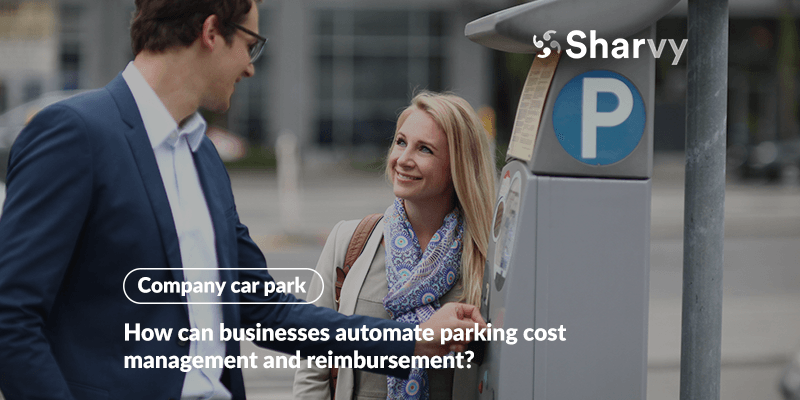
Are your staff struggling to find a parking space when they come into the office? Do some of them have to pay for parking near the office because there are no spaces available? Are you wondering whether these costs should be reimbursed and how to handle these requests without increasing the volume of email exchanges and manual processing?
With the rise of hybrid working, parking management has become a real challenge for many companies. Between car parks that are underused on some days and full to bursting on others, one-off reimbursement requests and the need to ensure a seamless employee experience, HR teams and general services departments are facing new challenges.
In this article, we take a look at the UK regulations governing home-to-work parking expenses, the best practices to implement and the solutions available to automate parking management. Let’s take a closer look.
Commute parking costs: what are we talking about?
Before addressing issues such as reimbursement and automation, it is important to define exactly what home-to-work parking costs entail.
Unlike parking costs incurred during business travel, home-to-work parking costs refer to the expenses incurred by an employee to park their vehicle when travelling to their usual place of work. These costs may be one-off or recurring, depending on the company’s organisation and the facilities available on site.
In practice, several scenarios may arise:
-
- An employee uses a paid public car park near the premises.
- They take out a monthly subscription at a private car park near the company.
- They have to pay one-off parking charges on the days they are at work.
- They park off-site due to a lack of available spaces in the company car park.
This issue is affecting an increasing number of organisations. With the rise of hybrid working, parking requirements fluctuate significantly from one day to the next. Some spaces remain unoccupied when staff are working from home, whilst busy days can lead to the company car park becoming full, forcing some staff to use paid parking solutions.
The difficulties are particularly acute in large urban areas where parking is limited and expensive. For employees, these costs can quickly add up to a significant expense. For companies, they raise issues of fairness, resource management and mobility policy.
Should the company reimburse commuting parking costs?
This is one of the most frequently asked questions from both employers and employees: when an employee has to pay for parking to get to work on site, is the company obliged to cover this expense? The answer is simple: in most cases, no.
↪ There is no legal obligation to reimburse parking costs.
Unlike parking costs incurred during business travel, parking expenses for commuting between home and a permanent workplace are generally considered personal expenses in the UK. As a result, employers are not legally required to reimburse these costs.
This is because the daily journey between home and work is regarded as the employee’s personal responsibility, including the choice of transport. Therefore, an employee who chooses to drive and pay for parking near their usual workplace cannot claim reimbursement as a legal entitlement. Employers may still choose to cover these costs through their own mobility or benefits policy.
↪ The employer’s obligations relate to public transport.
Unlike in some European countries, UK employers are not legally required to reimburse employees for the cost of commuting by public transport. However, many employers choose to support sustainable travel by offering benefits such as season ticket loans, public transport subsidies or salary sacrifice schemes. These initiatives help reduce the upfront cost of commuting while encouraging employees to use public transport.
↪ In what circumstances can a company choose to reimburse parking costs?
Even where there is no legal obligation, some companies decide to cover all or part of their employees’ parking costs.
This decision may serve several purposes:
-
- To improve the employee experience.
- To make it easier for staff to return to the workplace.
- To compensate for the lack of on-site car parking.
- Support a specific mobility policy.
- Addressing geographical and organisational constraints.
For example, a company based in a city centre where parking is limited may choose to contribute towards parking costs. Similarly, some organisations offer one-off reimbursements when the on-site car park is full.
Why introduce a parking reimbursement policy?
Although the law does not require employers to reimburse commuting parking costs, an increasing number of companies are choosing to address this issue through a dedicated policy. Why? Because parking has become a key factor in employee experience, fairness and the organisation’s appeal.
1. Making it easier to come into the office.
In the age of hybrid working, convincing staff to return to the office has become a challenge for many organisations. However, when coming into the office involves spending several minutes looking for a space or paying for a nearby car park, the employee experience can quickly deteriorate.
Introducing a policy to cover parking costs therefore helps to reduce certain barriers to coming into the office and offers greater convenience to the employees concerned.
2. Addressing specific geographical constraints.
Not all companies enjoy the same level of accessibility. Sites located in city centres, in busy business districts, or in areas poorly served by public transport often face more significant parking issues.
In such situations, contributing towards parking costs can be a solution to support staff and take account of the real constraints they face.
3. Promoting fairness amongst staff.
The issue of parking is often a source of frustration. Some employees have an allocated parking space, whilst others have to park elsewhere and bear the additional costs.
A clear policy helps to establish transparent rules: who is eligible for a parking space? In what circumstances is reimbursement possible? What priority criteria are applied?
The aim is not necessarily to reimburse everyone, but to ensure fair and understandable treatment for all staff.

4. Enhancing the company’s appeal.
Mobility benefits are now among the factors candidates consider when choosing an employer. Just like remote working and travel passes – such as the sustainable mobility allowance – covering parking costs can help strengthen the employer brand.
For certain groups, particularly in areas where a car remains essential, this benefit may even be a deciding factor.
5. Better control of parking-related costs.
Paradoxically, implementing a parking policy also helps to better control expenditure. By setting out clear rules, reimbursement caps and eligibility criteria, the company avoids ad hoc requests being dealt with on a case-by-case basis and minimises the risk of inconsistencies.
This approach also provides greater insight into actual parking needs and makes it easier to manage the associated costs.
A policy that should not be limited to parking reimbursement.
However, reimbursing parking costs is not always the most effective solution. In many companies, the real challenge lies primarily in optimising the use of available spaces.
Before covering external parking costs, it is often worth assessing the actual occupancy of the company car park: are the spaces being used to their full potential? Do some remain unoccupied when staff are working from home? Are the allocation rules suited to new ways of working?
It is precisely these issues that car park management solutions such as Sharvy address, enabling companies to optimise their parking spaces and reduce their reliance on external paid car parks.
How can you automate company car park management with Sharvy?
↪ Book a parking space before arriving on site.
One of the main challenges facing businesses today is ensuring that staff can see which spaces are available before they arrive at the office. Without a booking system, some staff may arrive on site with nowhere to park, whilst spaces sometimes remain unoccupied all day.
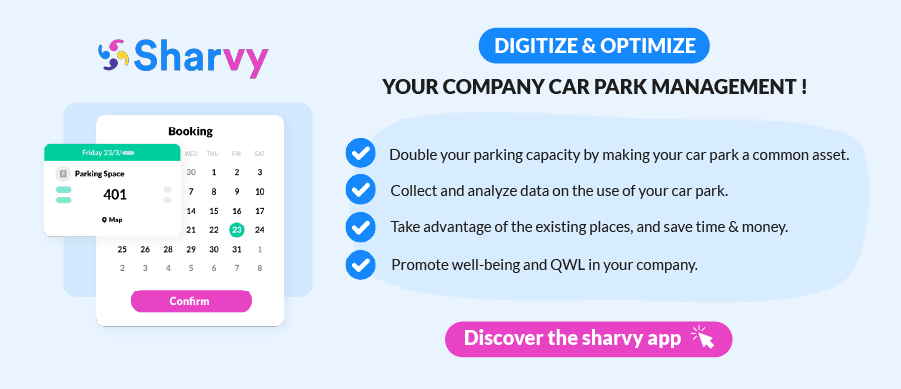
With Sharvy, staff can check availability in real time and reserve a parking space in just a few clicks, based on the days they are due to be in the office. If they are working from home or are absent, their reservation can be released (if they are a regular user) to make the space available to other users.
This helps to increase the car park’s utilisation rate and reduce instances where staff are forced to park in an external pay-and-display car park due to a lack of available spaces.
↪ Prioritise access to the company car park according to internal rules.
Not all parking spaces are intended to be allocated in the same way. Some companies, for example, wish to give priority to staff who are on site every day, to people with disabilities and pregnant women, as well as to those with specific mobility requirements.
Sharvy makes it easy to configure these allocation rules to automate access to spaces according to criteria defined by the company. This approach promotes fairer parking management whilst minimising manual decision-making and frustration.
↪ Reduce reliance on external paid car parks.
When a company car park is poorly managed, some staff may be forced to park in nearby public or private pay-and-display car parks.
By optimising the use of available spaces and improving their turnover, Sharvy helps to reduce these situations. Employees have a clearer view of which spaces are available, which reduces the need for external parking solutions.
↪ Centralise all parking-related requests.
Car park management is not limited to booking spaces. Cancellations, special requests, access management and usage monitoring: these are all tasks that can quickly become time-consuming when handled manually.
Sharvy centralises all this information on a single platform. HR, workplace and facilities teams thus gain a clear overview of usage and can manage their parking policy more effectively.
↪ Charge for certain parking spaces directly via the Sharvy app.
Sharvy also enables companies to implement a pay-per-use system for certain parking areas if they wish. For example, it is possible to charge for spaces reserved for visitors or to ask staff to contribute towards the cost of using specific spaces and services (charging points, company bike hire, etc.).
The entire process is automated within the platform, which eliminates the need for manual administrative tasks and ensures transparent management for all users.
Finally, how can you establish a clear policy for reimbursing parking costs?
If the company chooses to cover certain parking costs, it is essential to set out precise rules to ensure fair treatment and avoid having to deal with requests on a case-by-case basis.
In particular, the parking policy must specify the circumstances entitling staff to a reimbursement (on-site car park full, one-off visits to the premises, specific constraints, etc.), the conditions for reimbursement, any applicable limits, and the supporting documents to be provided.
Clear communication with staff also helps to minimise misunderstandings and simplify administrative management. The aim is to have a transparent, consistent framework that is easy for all stakeholders to apply.
In conclusion
Although employers are not legally obliged to reimburse parking costs incurred by staff for their journeys between home and work, parking has become a key issue in terms of organisation and the employee experience. Between the widespread adoption of hybrid working, difficulties in accessing certain sites and the need to ensure fair management of available spaces, it is in companies’ best interests to structure their parking policy.
However, even before considering the issue of reimbursing parking costs, it is often worth examining how existing resources are being used. Better management of available spaces not only helps to limit the use of external paid car parks but also reduces the administrative burden associated with reimbursement claims.
With a solution such as Sharvy, companies can prioritise space booking, set allocation rules tailored to their needs, centralise parking requests and, where necessary, implement simplified billing for certain parking zones. The result: more efficient, fairer and more transparent management for all staff.
Got a question? Check out the following FAQ!
Are parking charges considered business expenses?
Parking costs incurred during a business trip may be considered business expenses and reimbursed by the employer. However, parking costs incurred during the journey between home and work are generally treated as personal expenses.
How can we reduce the number of parking fee reimbursement claims?
The best solution is often to optimise the use of existing parking spaces. By allowing staff to book their spaces in advance and improving car park occupancy rates, companies reduce the number of situations where employees are forced to use paid off-site parking.
Can parking spaces be charged for via Sharvy?
Yes. Sharvy allows you to set up a pay-to-park system for certain parking areas. For example, companies can charge for visitor spaces or ask employees to contribute financially in line with their internal policy. The entire process is automated within the platform.
Fancy finding out more? Check out our latest articles to stay up to date!
What if your company car park became a source of income?
Vous souhaitez que votre parking d’entreprise vous génère des revenus? Découvrez 5 idées (simples & innovantes) pour monétiser votre parking!
Serviced real estate: can company car parks be a key differentiator?
What is a serviced real estate? Can company car parks become a key differentiator for businesses by 2026? Focus!
Company car parks & electric charging points: towards unified management?
How can you centralise the management of company car parks and electric charging points? What are the benefits? How do you go about it?