
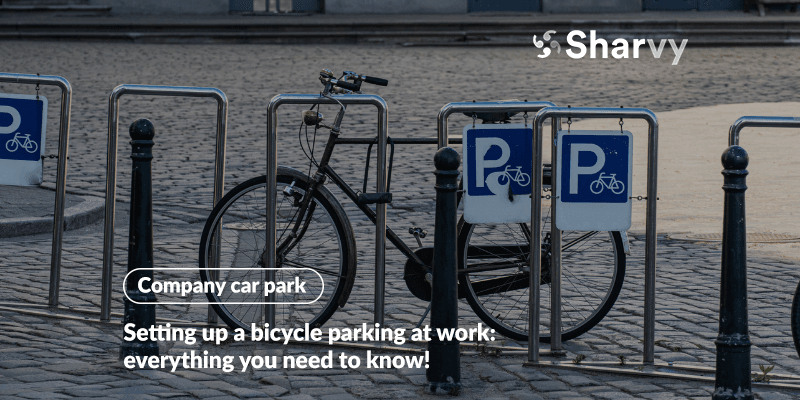
8.45 am. The first staff members arrive at the office. Some park in the company car park, others get off the bus, and a few are desperately looking for somewhere to lock up their bikes. A post, a fence, a tree: in the absence of suitable facilities, makeshift solutions are improvised.
Yet cycling has never been more popular. Every day, more and more staff are choosing to cycle to work, attracted by a mode of transport that is economical, practical and environmentally friendly. This trend is prompting businesses to rethink their spaces and incorporate new mobility solutions.
But how can this transition be supported? What type of bicycle parking should be installed? How many spaces should be provided? How can the safety of the facilities and the comfort of users be guaranteed? And beyond the practical aspects, what benefits can such a facility bring to your business? Focus in this article.
Why install a bicycle parking facility at your workplace?
Imagine for a moment two neighbouring businesses. At the first, staff who cycle to work have to make do as they go along every morning: a padlock clipped to a railing, a bike left out in the rain, another parked several hundred metres from the offices. At the second, a dedicated, secure and, above all, easily accessible space awaits them as soon as they arrive.
Which one would make you more likely to cycle to work?
At a time when travel habits are changing, businesses have a key role to play in supporting these new habits. Setting up a bicycle parking is not simply a matter of creating a few extra parking spaces. It is a facility that makes employees’ daily lives easier, encourages sustainable travel and demonstrates a concrete commitment to well-being at work.
For staff, there’s no longer any need to worry about the risk of theft, bad weather or a lack of space to park their bikes. As a result, the barriers to cycling are gradually disappearing and cycling is becoming a more natural option for commuting.
Bicycle parking at work: what you need to know about the legal requirements.
In the UK, bicycle parking requirements are generally set through local planning policies rather than a national obligation. In practice, most new commercial, industrial and public-facing developments are expected to provide secure, accessible and convenient cycle parking facilities as part of their planning approval. The aim is simple: to encourage cycling and ensure that employees and visitors have access to safe and practical cycle parking that meets their needs.
↪ How many cycle spaces should be provided?
For workplace developments in the UK, the number of cycle parking spaces required is typically determined by local planning policies and the nature of the building. Requirements often take into account factors such as the size of the workforce, the building’s floor area and its location.
While the exact provision will vary from one local authority to another, employers should aim to provide enough cycle parking to meet both current and future demand. In practice, planning ahead can help avoid overcrowding and support a growing number of employees choosing to bicycle to work.
↪ What requirements must a cycle parking facility meet?
Bicycle parking provision is not only about the number of spaces available. To be effective, facilities should also be designed with security, accessibility and user convenience in mind.
In general, cycle parking should:
- Allow bicycles to be securely locked.
- Enable the frame and at least one wheel to be secured to a fixed stand.
- Provide sufficient space for easy access, manoeuvring and parking.
- Be accessible and convenient for regular users.
- Be located in a well-lit area with good natural surveillance wherever possible.
Where bicycle parking is provided outdoors, it should ideally be located close to the building entrance to encourage use and maximise convenience for employees and visitors.
↪ Security: a criterion that has become essential.
In commercial buildings, access to areas reserved for bicycles must be controlled by a secure locking system (key, access card, access control via an app such as Sharvy, etc.).
Where facilities are located outdoors, they must be designed to effectively protect bicycles not only against theft but also against the elements. Covered, enclosed and properly lit facilities are now strongly preferred.
So, what type of bicycle parking should you choose for your business?
Not all bicycle parking facilities are suitable for the same purposes. The choice depends in particular on the number of cyclists to be accommodated, the level of security required, the space available and the budget allocated to the project. A facility suitable for a small business will not necessarily be appropriate for a head office accommodating several hundred staff.
↪ Bike racks: the simple and cost-effective solution.
Bicycle racks are the most common solution. Simple to install and inexpensive, they allow users to secure the frame and one wheel to a fixed point, in line with safety recommendations.
They are particularly suitable for businesses wishing to provide functional cycle parking without carrying out major works. However, bicycles remain exposed to the elements and offer only limited protection against theft.
↪ Covered cycle shelters: greater comfort in everyday life.
To enhance the employee experience, many businesses choose to install a covered shelter. This solution protects bikes from rain, sun and bad weather, whilst enhancing the company’s outdoor spaces.
↪ Secure shelters: the preferred solution for businesses.
With the rise of cycle commuting and electric-assist bikes (e-bikes), security has become a key consideration. Secure shelters help minimise the risk of theft through access control restricted to authorised users.
Some solutions, such as Sharvy, go even further by linking access to a prior booking. Employees book their bike space via the app and can then unlock the door to the secure shelter on arrival. Without an active booking, access remains locked.
This system ensures that spaces are used efficiently, prevents unauthorised use and guarantees cyclists an available space in a secure area.
Additional equipment to be provided.
↪ Charging points for electric bikes.
With the growing popularity of electric bikes (e-bikes), installing charging points or sockets within the car park helps meet users’ new needs and makes longer journeys easier.
↪ Repair and tyre-inflation station.
A flat tyre or a minor adjustment shouldn’t stop an employee from cycling to work. A station equipped with a pump and basic tools is a simple service, but one that is particularly appreciated on a day-to-day basis.
↪ Changing rooms, showers & lockers.
For staff who cycle several kilometres and those who use their bikes all year round, having a space to get changed and store their belongings is a real convenience. These facilities help to remove certain barriers to cycling and improve the experience for staff.
However, it is true that some of these facilities can be in high demand within the company. Without proper organisation, their use can sometimes lead to conflicts and periods of high demand.
Introducing a booking system, such as the one offered by Sharvy, helps to streamline access to these facilities. Employees can book a bike parking space, a shower or a locker in advance directly via the app, whilst the company optimises the use of its facilities and has a clear overview of their occupancy rates.
What budget should you set aside for a company cycle park?
In reality, the budget depends above all on the scope of the project. Do you simply want to offer a few parking spaces to your staff, or create a fully-fledged space dedicated to sustainable transport, which is secure and equipped with additional services?
From a few bike racks installed near the building to a secure shelter with access control, charging points and changing rooms, the requirements (and therefore the costs) can vary considerably.
Several factors influence the budget for a cycle parking scheme:
- The number of spaces to be created.
- The type of facility chosen (bike racks, covered shelter, locked room, secure shelter, etc.).
- The desired level of security.
- The necessary installation work.
- Any additional facilities made available to users.
But rather than viewing this project as a mere expense, it is worth seeing it as an investment. A well-designed cycle park encourages the adoption of sustainable transport, improves staff comfort and helps to strengthen the image of a company committed to environmental issues.
Indeed, the most forward-thinking companies no longer simply offer a parking space. They create a genuine ecosystem dedicated to cyclists: secure parking spaces, charging points for electric bikes, lockers, showers and even booking systems to efficiently manage access to the various facilities.
The key is to strike the right balance between budget, staff needs and future growth prospects.
In conclusion
Cycling now plays a key role in commuting. In light of this trend, companies would be well advised to adapt their infrastructure to support these new habits and meet their employees’ expectations.
The success of a project depends above all on accurately anticipating needs: choosing the right type of facility, ensuring adequate capacity, and incorporating facilities that will make cyclists’ daily lives easier.
Any questions? Check out the following FAQ!
Is a bicycle parking mandatory for all businesses?
No. The requirements depend, in particular, on the type of building, its date of construction and any work carried out. However, some companies must provide cycle parking facilities that comply with regulations if they have a car park or are carrying out major renovations.
How can you prevent the bicycle parking from being used by unauthorised people?
Businesses can set up access control systems such as badges, codes or smart locks. Some solutions, such as Sharvy, even allow access to be conditional on a prior booking, thereby ensuring that only users with a reserved space can access the secure area.
Is there any financial support available for setting up a cycle park at a business?
Yes. Depending on the company’s location and the nature of the project, certain local authorities, regions or public bodies may offer grants for the development of infrastructure that promotes sustainable mobility. It is advisable to check with local authorities before launching the project.
Fancy finding out more? Check out our latest articles to stay up to date!

Employee experience and employer brand : the challenge of digital
The use of digital applications and services can improve the employee experience and therefore the employer brand.