
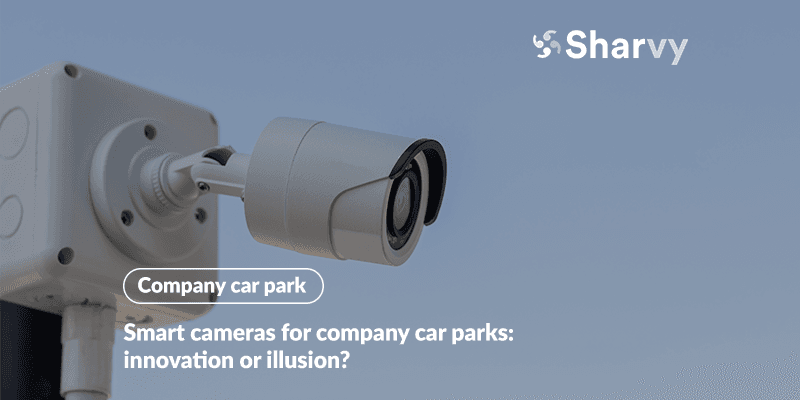
A company car park, in its most common form, remains a fairly simple system: a barrier, an access badge, and a concentration of arrivals at the same times every day. There is nothing new about the principle, but small technological tweaks have been added over time.
Among these, smart cameras capable of automatically reading number plates have gradually been installed at certain sites. The idea is simple: to recognise a vehicle and grant access without human intervention.
But ultimately, does this really transform the day-to-day experience? Is it a practical improvement or simply an extra layer of technology on top of a system that was already working?
Between the promise of automation and the reality on the ground, the value of these systems depends above all on how they are used. In some cases, they offer real convenience. In others, they remain a useful development, but not necessarily essential. Let’s take a closer look!
What do we mean by smart cameras and how do they work?
Smart cameras refer to video surveillance devices capable not only of capturing images, but also of analysing them automatically to extract useful information and trigger actions in real time.
In the context of company car parks, they are most often associated with number plate recognition, often referred to as LPR (Licence Plate Recognition) or ANPR (Automatic Number Plate Recognition).
Their operation relies on a technological chain: the camera first detects the arrival of a vehicle, captures an optimised image of the scene, and then analysis software (often based on OCR and AI algorithms) identifies the characters on the number plate.
This data is then compared against an authorisation database (staff, visitors, prohibited vehicles), enabling an automated decision to be made, such as opening a barrier or denying access. Thus, these cameras no longer merely monitor; they interpret what they see and play a direct role in managing access to the company car park.
Why are companies (increasingly) adopting these systems for their car parks?
The appeal of number plate recognition cameras in company car parks rests above all on a simple promise: to eliminate friction at the entrance.
In large companies and multi-building sites, vehicle traffic can cause congestion at peak times. The idea is therefore to eliminate unnecessary stops: no more badges to present, no more tickets to collect, no more calls to a security guard.
But beyond convenience, companies also see it as a tool for smart access management:
-
- Automated access for regular staff.
- Simplified visitor management via temporary authorisation.
- Precise monitoring of entry and exit times.
- Complete logging of entries and exits.
Another key point: centralisation. These systems can often be integrated into a comprehensive physical security platform, alongside building access controls, alarms and CCTV.
Finally, the HR aspect and employee experience should not be underestimated: arriving at work without waiting or forgetting a badge is a small detail… but one that matters in how modern a company is perceived to be.
Market players & available solutions.
The market for smart cameras for corporate car parks is organised around several complementary groups of players.
On the one hand, video surveillance equipment manufacturers supply cameras and number plate recognition technologies, such as Axis Communications, Hikvision and Bosch Security Systems.
On the other, security software platforms enable the centralisation and orchestration of access flows, such as Genetec, which integrates number plate recognition into broader access control systems.
Finally, specialised car park management solutions complete this ecosystem, such as Sharvy, which optimises and manages the allocation of parking spaces within a company.
Sharvy can, for example, interface with access control and number plate recognition systems to automate the opening of barriers, streamline entry and synchronise access rights for both staff and visitors in real time.
This synergy between hardware, security software and car park management enables the creation of modular solutions, suitable for both large, complex sites and businesses looking to optimise their parking space.
The benefits of smart cameras in a corporate environment.
When properly deployed, a number plate recognition system can transform the management of a corporate car park.
The first benefit is obvious: improved flow. At peak times, saving just a few seconds per vehicle is enough to significantly reduce queues. On a site with several hundred employees, the impact is immediate.
Next comes the reduction in operational workload. Fewer badges to manage, fewer visitor tickets, and fewer human interventions at the barriers. In most cases, the system becomes fully autonomous.
Another often-overlooked benefit is traceability. Every entry and exit is recorded: who entered? At what time? In which vehicle?
This can be useful both for security and for analysing traffic flows (car park occupancy, peak times, space optimisation, etc.).
Finally, flexibility is a major asset. Businesses can create dynamic rules: temporary access for contractors, specific time slots for certain services, remote exceptional authorisations, etc.
The car park then becomes a data-driven space, rather than simply a physical infrastructure.
The often underestimated limitations and constraints of smart cameras.
Despite its reputation as a is not infallible. And this is often where projects encounter their first disappointments.
For example, recognition accuracy is reduced as soon as conditions deviate from the ideal scenario: heavy rain and glare on number plates, poorly calibrated night-time lighting, dirty, damaged or partially obscured number plates, and finally, if there are sub-optimal approach angles. The result: number plates read incorrectly, or not read at all.
What’s more , the technology is not infallible and can occasionally generate identification errors, leading to an authorised vehicle being denied access or requiring manual intervention.
These solutions also rely on a reliable software and network infrastructure, which requires regular maintenance, updates and appropriate technical supervision.
Finally, the management of data relating to number plates must comply with a strict regulatory framework, particularly regarding the protection of personal data.
So, is this genuine innovation or a technological illusion?
Very often, they represent genuine innovation when deployed in environments with high vehicle traffic. At large corporate sites, they help streamline entry and exit, reduce waiting times, and efficiently automate access control. They are also particularly valuable in contexts where security requirements are high, thanks to improved vehicle traceability and centralised authorisation management.
When combined with parking management solutions such as Sharvy, these technologies can offer a smoother experience for staff whilst simplifying access administration for the company.
On the other hand, for smaller facilities or car parks with low vehicle turnover, these systems can sometimes be over-engineered. The costs of installation, maintenance and integration are not always justified for simple needs that could be met by more traditional solutions.

In conclusion
Smart cameras are neither a mirage nor a miracle solution. It is a relevant technology when it meets a genuine operational need, but it can sometimes be presented as a one-size-fits-all solution, whereas not all corporate car parks face the same challenges.
Ultimately, their effectiveness depends above all on the context of use and the maturity of the company’s needs. When integrated into a coherent ecosystem combining access control, authorisation management and traffic monitoring, they can genuinely simplify day-to-day operations and improve the user experience.
Any questions? Check out the following FAQ!
Is this suitable for all businesses?
Not necessarily. These solutions are particularly suitable for sites with heavy vehicle traffic or significant security concerns. For smaller or less busy car parks, simpler systems may suffice.
Can badges or remote controls be completely replaced?
In some cases, yes, but many businesses opt for a hybrid approach. Number plate recognition is often combined with other access methods to ensure service continuity in the event of a technical failure.
Is number plate data secure?
Yes, but this depends on the solution implemented. As number plates constitute personal data, their processing must comply with applicable regulations, notably the GDPR, with appropriate security and retention measures.
Want to find out more? Check out our latest articles to stay up to date!

Fairness at work : the foundation of the employee experience ?
What is fairness at work? Why is it so important in the workplace? How can fairness be guaranteed? Find the answers here!

Smart building : the benefits for employees and employers!
What is a smart building? What advantages does it offer? What challenges does it address? Find out in this article.

Company relocation : an opportunity to give a fresh start!
Are you about to carry out a company relocation? In this article, find out our top tips for getting the most out of your move.