
What is the true return on investment for a company car park these days? And, more importantly, how many companies actually know how to measure what their car park brings in and what it costs them?
In many cases, the answer is simple: very few.
A parking space is often thought of as a fixed asset, whereas in reality, its occupancy rate can vary significantly depending on the day, periods of remote working and staff travel habits.
The result: a fixed asset, rarely optimised, which adds to costs without generating commensurate value. Yet, with the right tools, a car park can become a high-yield space.
But how can this under-utilised potential be transformed into measurable performance? And above all, how can each space be better utilised on a daily basis without complicating management? We explore this in this article.
Why is a company car park a strategic asset?
A company car park is never neutral. It is an expensive space, in constant use, whose value depends directly on how it is used. Yet, in many cases, part of its capacity remains unused, without this being particularly noticeable.
This is where the problem lies: a fixed asset that is rarely optimised.
Yet its impact on day-to-day operations is very real. It is the first and last point of contact for many employees with their workplace. A smooth arrival, a space available without hassle, easy access: these factors directly influence the quality of the on-site experience.
But this balance is becoming increasingly difficult to maintain. Working patterns have changed, office attendance has become variable, and usage is no longer linear. Despite this, many car parks are still managed as if they were designed to accommodate a constant and predictable flow of traffic.
The result is often the same: empty spaces on some days, unnecessary pressure on others, and an overall efficiency lower than what the infrastructure could actually deliver.
The causes of low efficiency in traditional company car parks.
The first cause is simple: the under-utilisation of parking spaces. Between remote working, holidays, travel and staggered working hours, a significant proportion of spaces remain empty for much of the time, without being reallocated.
Then there is the fixed allocation model. Many car parks still operate with spaces dedicated to specific individuals. The result: a space may go unused whilst other staff members need it on the same day.
Another problem is the lack of visibility. Without accurate data on actual occupancy, it is difficult to understand when and how the car park is being used, and therefore to adjust management accordingly.
Finally, management is often not very digitised. If bookings are made, they are sometimes done manually (using Excel) or informally, which prevents any dynamic optimisation and makes management inefficient.
Ultimately, these combined limitations prevent the car park from being used as a flexible resource, capable of adapting to the company’s actual needs.
5 ways to optimise the efficiency of a company car park.
↪ Pool parking spaces to avoid wastage.
Pooling involves gradually moving away from the traditional “one space per user” model in favour of shared use. In practice, a single parking space can be used by several employees at different times of the day or week.
This is a powerful lever as it has an immediate impact on the occupancy rate. A space that was reserved but unused on certain days becomes available to others, without the need for new infrastructure.
This approach also helps to better accommodate natural fluctuations: remote working, absences, business travel. The car park adapts rather than remaining static.

↪ Adapt usage to actual attendance.
A car park’s efficiency depends directly on its ability to keep pace with the business. However, attendance patterns are no longer consistent: some sites are very busy on Tuesdays and almost empty on Fridays.
Adapting usage means aligning the allocation of spaces with these fluctuations. This can be achieved through one-off bookings or by allocating spaces only when the employee is actually present.
This avoids spaces being « by default » and unused. The car park becomes more fluid, fairer and, above all, more efficient in its day-to-day use.
↪ Digitise your company car park management.
Without a suitable solution, managing a company car park (all too often) relies on Excel spreadsheets, email exchanges and informal rules. This approach may work on a small scale, but it quickly becomes inefficient as usage patterns become more complex or footfall varies from day to day.
Digitisation allows all information to be centralised: space availability, bookings, allocation rules, access and occupancy history. For HR, office management and facility management teams, this means less manual administration, fewer errors and a clear, real-time overview of car park usage.
For staff, the impact is immediate. They can book a space in advance, know where and when to park, and avoid the uncertainty of « “Will I find a space today?” ». This smooth process significantly improves day-to-day convenience and reduces parking-related stress.
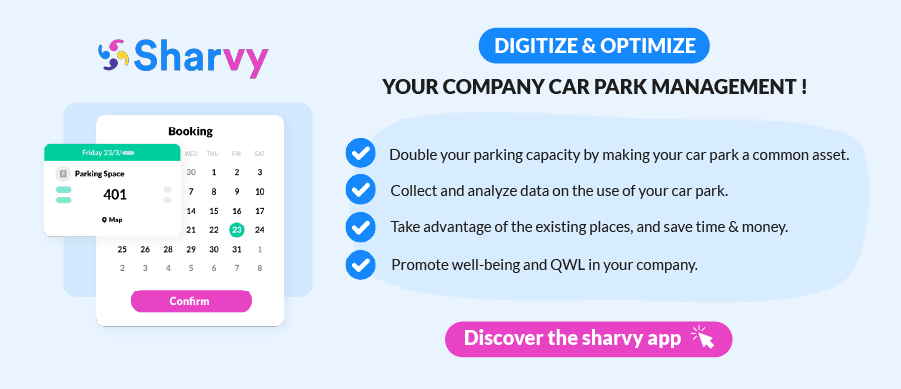
In line with this, solutions such as Sharvy enable precisely this management to be structured and automated. The app facilitates space booking, the sharing of spaces and real-time monitoring of occupancy, whilst simplifying coordination between teams and users.
↪ Manage with concrete data.
A company car park cannot be optimised without a clear picture of its (actual) usage. Data helps identify days of under-utilisation, peak times and the most popular areas.
This approach transforms intuitive management into objective management. It « no longer simply assume » that the car park is full or empty: we measure it.
Over time, this data enables you to adjust allocation rules, better gauge requirements and gradually improve overall efficiency.
↪ Automate the allocation of parking spaces.
Automation takes things a step further. Instead of manually managing requests and allocations, predefined rules can automatically allocate available spaces.
These rules can take several criteria into account: frequency of attendance, job priority, car-sharing, specific requirements (people with reduced mobility, pregnant women), etc.
The main benefit is twofold: reduced administrative burden and better utilisation of available resources, without the need for constant manual intervention.
The role of Parking Management solutions, such as Sharvy.
Improving a car park’s efficiency does not rely solely on better internal practices. The real lever is the ability to transform a rigid space into a manageable resource. This is precisely the role of Parking Management solutions.
Firstly, these tools enable the actual occupancy rate to be maximised. By replacing fixed spaces with dynamic management, each space can be used by several employees depending on the day and requirements, and allocated according to a fair algorithm. As a result, the company car park is no longer static, and every square metre is utilised more effectively.
They also provide a clear picture of performance. Thanks to occupancy data, it becomes possible to measure the car park’s performance: utilisation rates, periods of under-utilisation, and peaks in demand. This insight allows management rules to be continuously adjusted to improve overall efficiency.
Another direct impact on efficiency: the reduction in wasted parking spaces. Absences, remote working and travel no longer unnecessarily tie up spaces. They are automatically released back into the system and reallocated to other users. The Sharvy app also interfaces with your HRIS (Kelio, Lucca, etc.).
In practical terms, when an employee is working from home, on leave or on a business trip recorded in the HRIS, their parking space is no longer unnecessarily blocked. It is automatically released and made available to other users for the day in question.
In conclusion
Ultimately, a company car park is a property asset in its own right, the return on which depends directly on how it is managed on a day-to-day basis.
When managed rigidly, it generates hidden costs and remains largely underutilised. Conversely, as soon as it is shared, monitored and adapted to actual usage, it becomes a driver of performance: higher occupancy rates, cost optimisation and an improved employee experience.
The key therefore lies in flexibility and data. Understanding usage patterns, adjusting the rules and relying on suitable tools. With this in mind, solutions such as Sharvy enable companies to take a significant step forward by making car parks smarter, more efficient and, above all, more profitable.
Any questions? Check out the following FAQ!
How do you measure the performance of a company car park?
The performance of a car park is mainly measured by its actual occupancy rate over a given period. You can also analyse the turnover rate of spaces, periods of under-utilisation and the ratio between available capacity and actual usage.
Is an empty car park necessarily a problem?
Not necessarily, but a car park that is regularly under-utilised often indicates a lack of optimisation. The challenge is to identify whether this under-utilisation is structural (oversized) or organisational (poor allocation of spaces).
Is it possible to improve efficiency without building new spaces?
Yes, that is in fact the main objective. By pooling spaces, introducing flexibility and digitising management, it is possible to significantly increase the utilisation rate without increasing capacity.
Want to find out more? Check out our latest articles to stay up to date!

Future of work : what trends and technologies lie behind this notion?
Between utopia and dystopia, what can managers expect and how can they prepare for the “Future of work” ? The answers here!

Work environment : 10 golden rules for improving it!
Discover 10 golden rules for improving your employees’ work environment, enhancing their well-being & their QWL.

How to encourage employees to adopt sustainable mobility?
In this article, discover 6 ideas to improve your CSR policy and encourage your employees to take an interest in sustainable mobility!