
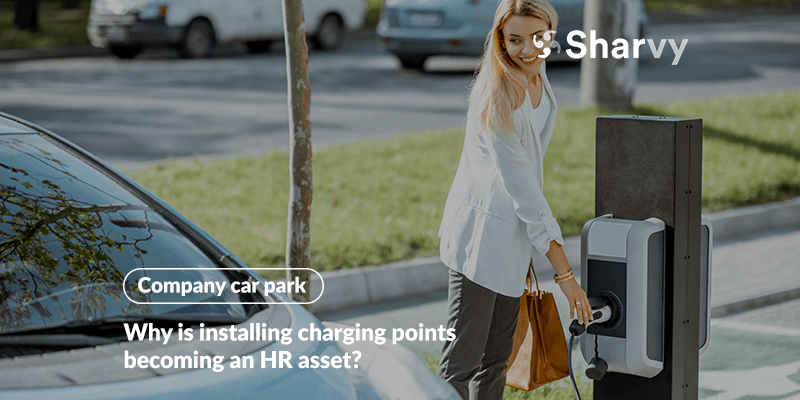
Electric cars are no longer a niche trend: in France, the number of electric and plug-in hybrid vehicles continues to grow rapidly, with over a million plug-in vehicles now on the road. This development is prompting companies to ask themselves a new question: how can they support their employees’ changing mobility needs?
After all, behind the energy transition lies a very practical challenge: recharging. For an employee who commutes by car every day, being able to recharge their vehicle during working hours offers considerable savings in time and convenience.
But installing charging points at work isn’t just about addressing a mobility challenge. It is gradually becoming a real HR asset, providing a tangible service to employees whilst reinforcing the image of a socially responsible company. We take a closer look in this article.
Electric vehicle charging at work: a new expectation among employees by 2026.
Travel habits are changing, and with them, employees’ expectations of their employers. Whilst just a few years ago, the ability to charge one’s vehicle at work might have been seen as a rare perk, it is gradually becoming a service expected by employees who have opted for electric mobility.
It is true that for an employee with an electric or plug-in hybrid vehicle, the issue of charging is part of their daily routine. Do they have to find an available public charging point after work? Do they have to alter their route to ensure they have enough range? Do they have to plan their journeys several days in advance? These constraints can quickly become a daily nuisance.
Consequently, by installing charging points in its car park, the company provides a simple solution to a practical need: enabling staff to make the most of their time at the office to charge their vehicles. A practical solution that improves their convenience, whilst showcasing the company as an organisation that is attentive to new trends and the concerns of its staff.

Why are charging points (now) a real HR asset?
Today, the employee experience is no longer limited to the tasks assigned or the atmosphere at work. It encompasses all the services and conditions that make employees’ daily lives easier, including their travel arrangements. According to APEC, Quality of Life at Work (QLW) has become a key factor in career choices: 45 per cent of managers consider working conditions to be an essential factor when deciding to join a company.
Against this backdrop, companies are seeking new ways to meet their employees’ practical expectations. A charging point in the car park therefore becomes a high-value-added service: it allows employees with electric vehicles to make the most of their time at work to charge their cars, without adding any extra burden to their personal schedules.
This type of initiative also addresses a major challenge for HR teams: retaining talent. In 2024, 70 per cent of HR professionals surveyed cited employee retention as their main concern, ahead of other HR challenges such as recruitment (2024 Tissot-Payfit Barometer). Offering services that genuinely improve day-to-day life can therefore help to reinforce the sense that the company cares about its staff.
More than just a piece of technical equipment, the charging point thus becomes a symbol of a company that anticipates changes in lifestyles, supports its staff in their new habits and transforms its car park into a genuine service hub.
Charging points as a tool for employer branding?
Nowadays, candidates and employees no longer judge a company solely on its rhetoric, but also on concrete evidence of its commitments. The question is therefore no longer simply: “What values do you espouse?’ », but rather: ‘«’ ‘What actions are you actually putting in place on a day-to-day basis?”.
With this in mind, charging points are becoming a real HR asset. Why? Because they enable a company to fulfil several commitments through a single service: supporting new forms of mobility, backing the green transition and providing a working environment adapted to changes in society.
According to a recent study, 76 per cent of millennials emphasise that a company’s social and environmental commitment is a more important criterion than salary. Although the criteria for choosing an employer vary depending on individual profiles, one trend is becoming increasingly clear: companies that are able to align their values with visible actions enhance their appeal to talent.
A charging point installed in a company car park thus becomes an easily recognisable symbol. It brings CSR commitments to life, whilst sending a positive message to staff: “Your company is evolving in line with your changing habits and supports you in your mobility choices”.
In a job market where it is becoming increasingly difficult for employers to stand out from the crowd, these initiatives can make all the difference! After all, an HR asset isn’t necessarily a spectacular perk: it’s often a simple, useful service that aligns with employees’ expectations.
Installing charging points is not enough: the importance of fair management.
Installing charging points in a company car park is an excellent first step. But a question soon arises: how can we ensure that this new benefit truly benefits all employees who need it?
After all, a charging point remains a shared resource. And just as with car park spaces, meeting rooms and flex-office workspaces, poor organisation can quickly lead to frustration. An employee who leaves their car plugged in all day, users who always book the same time slots, or a lack of visibility regarding availability can turn a service designed to make daily life easier into a real source of irritation.
The challenge, therefore, is not just to install charging points, but to create a simple and transparent system. Employees need to be able to easily find out when they can charge their vehicle, how long they can use a charging point, and how to share this equipment fairly with their colleagues.
To achieve this, several best practices can be implemented:
But when several staff members wish to access the same time slots, an additional question arises: how can we ensure true fairness among users? This is precisely where smart management of charging points comes into its own.
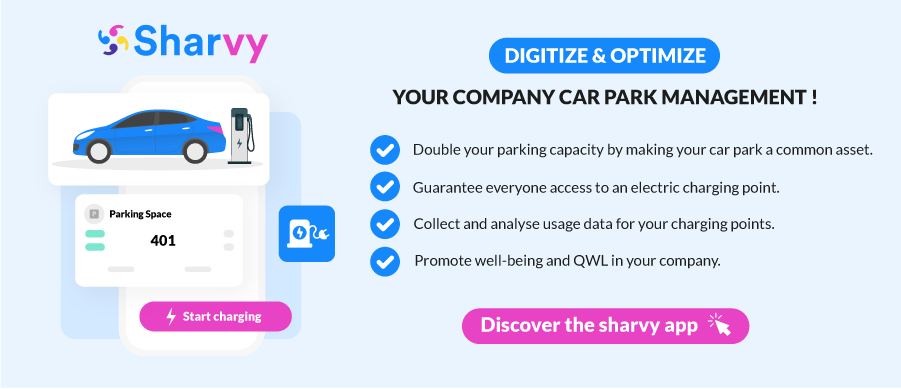
Rather than operating on a “first come, first served” principle, some solutions rely on fair allocation mechanisms. For example, the algorithm developed by Sharvy takes various criteria into account when allocating access to shared resources, including employees’ booking history over the last 60 days.
The aim is to prevent any one user from systematically monopolising the best time slots and to promote a more balanced distribution, whilst also being able to incorporate other parameters defined by the company (priorities, user profiles, specific needs, etc).
This is when the charging point truly becomes an HR asset. It is no longer simply a socket installed in a car park, but a service designed with the employee experience in mind: easy to access, fair and tailored to day-to-day needs.
The benefits for the company: why invest in charging points?
↪ An investment that supports new forms of mobility.
Companies today must anticipate changes in how their staff travel, as well as in their own business fleets. Between the gradual electrification of company cars, regulatory requirements and carbon emission reduction targets, the issue of charging is becoming a strategic priority.
Installing charging points therefore enables a business to prepare for the mobility solutions of tomorrow, rather than having to respond urgently to growing demand. It is also a practical way of supporting employees who wish to switch to an electric vehicle, by removing one of the main barriers to its use: access to a simple charging solution.
↪ A way to showcase your CSR commitments.
CSR policies are no longer measured solely by statements or long-term objectives. Employees, job applicants and partners now expect visible and measurable actions.
Charging points are precisely such an easily identifiable commitment: they demonstrate a willingness to act in favour of more responsible mobility and give a tangible dimension to the company’s environmental strategy.
They can also help monitor ESG initiatives by providing usage data: the number of charges carried out, energy consumption, trends in electric vehicle usage, etc. These are useful indicators for measuring the real impact of the actions implemented.
↪ Turning a constraint into an opportunity through usage data.
Investing in charging points does not necessarily mean installing more equipment without understanding the needs. By monitoring usage, the company can better understand its employees’ actual needs: which charging points are used most frequently? At what times is demand highest? Is the number of charging points adequate?
This approach helps to avoid both under-provisioning and over-investment. The charging point then becomes a data-driven service, capable of evolving in line with the company’s needs.
↪ Turning the car park into a genuine space for employee services.
Through charging points, the whole concept of the company car park is ultimately evolving. Long regarded as a mere logistical constraint, it is becoming a new space that contributes to the employee experience.
Combined with smart management, charging points therefore enable the creation of a useful service that meets employees’ current expectations and, above all, is aligned with companies’ strategic priorities.
This is precisely what makes charging points a genuine HR asset: they do not merely meet a technical need; they help to build a more modern, more responsible working environment that is better suited to new ways of working.
In conclusion
Charging points should no longer be viewed simply as equipment related to electric mobility. They are now part of a broader approach to the services offered to employees and the evolution of workspaces.
When designed as a genuine service, with appropriate and fair management, they enable companies to support new ways of working whilst strengthening their HR policy, their CSR approach and their mobility strategy.
The challenge, therefore, is not merely to install charging points, but to create an experience that is simple, accessible and useful in everyday life. It is this approach that transforms technical infrastructure into a genuine HR asset, capable of delivering value to both employees and the company.
Any questions? Check out the following FAQs!
Why is it a good idea to manage charging points using a digital solution?
Providing charging points is a first step, but their day-to-day management (quickly) becomes a real organisational challenge. How can you ensure fair access when several employees want to charge their vehicles? How can you avoid forgotten bookings or charging points being occupied unnecessarily?
A digital solution simplifies this management by providing real-time visibility of availability, making it easier to book time slots and ensuring better monitoring of usage. The company can thus offer a smoother service to staff, whilst maintaining a clear overview of how its infrastructure is being used.
Solutions such as Sharvy enable the management of charging points to be integrated into a broader approach to managing shared resources within the company. Thanks to usage data, teams can better understand actual needs, identify periods of high demand and adjust their arrangements over time.
How can conflicts over the use of charging points in the workplace be avoided?
Establishing clear rules is essential: booking time slots, limiting usage times, monitoring occupancy and ensuring fair access. Structured management helps prevent frustration and guarantees a service that is accessible to all.
Fancy finding out more? Check out our latest articles to stay up to date!

Future of work : what trends and technologies lie behind this notion?
Between utopia and dystopia, what can managers expect and how can they prepare for the “Future of work” ? The answers here!

Work environment : 10 golden rules for improving it!
Discover 10 golden rules for improving your employees’ work environment, enhancing their well-being & their QWL.
How to encourage employees to adopt sustainable mobility?
In this article, discover 6 ideas to improve your CSR policy and encourage your employees to take an interest in sustainable mobility!
PARKING & WORKPLACE MANAGEMENT SOLUTION
Car park management - Charging points monitoring - Desk booking - Booking by time slots



LABELS & COMMUNITIES




SUBSCRIBE TO THE NEWSLETTER
Receive the latest Parking & Workplace trends by email once a month.

