
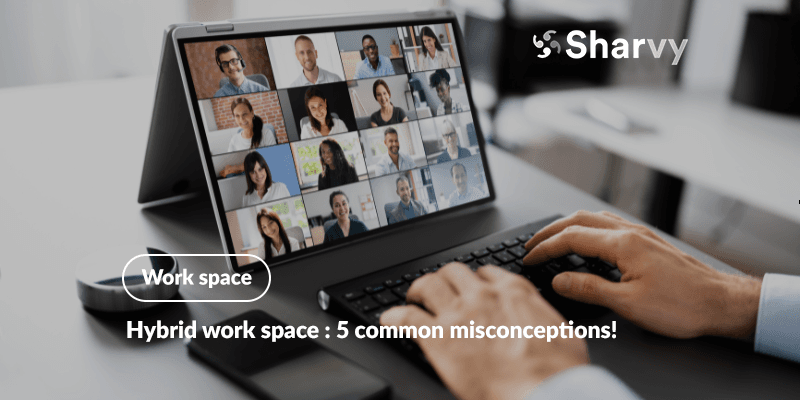
Hybrid work space is no longer a passing trend, it’s now the new reality in the professional world.
But like any revolution, hybrid working comes with its share of preconceived ideas. It is accused of undermining productivity, disengaging teams and making management more complex. In truth, these clichés mainly reflect a lack of understanding of this model, and a difficulty in rethinking our working habits.
In this article, we untangle the truth from the false by reviewing 5 preconceived ideas about hybrid working. The aim is to understand what lies behind these beliefs, and to discover how a structured approach, such as desk booking, can transform this flexibility into a real driver of performance and commitment. Focus on this!
Definition of hybrid work space in companies: a reminder!
Hybrid work space combines presence in the office with remote working, according to the needs of the company, its teams and its missions. The aim is not to measure performance by physical presence, but by the quality of results and collaboration.
It allows employees to choose where and when they are most effective: the office becomes a place to collaborate, exchange ideas and create links, while teleworking encourages concentration and autonomy.
Myth 1: Hybrid working reduces employee productivity.
This is one of the arguments most often put forward against hybrid working: if employees are less present in the office, they are bound to be less productive. This belief is (still) based on an old-fashioned view of work, where performance was measured by physical presence rather than by the results achieved.
However, numerous studies now show that productivity does not depend on location, but on the quality of the organisation. A well-structured hybrid working environment, with a clear division of time between concentration and collaboration, even encourages greater collective efficiency. Employees know when to come together as a team and when to concentrate on their tasks, which reduces wasted time and unnecessary interruptions.
In other words, hybrid working doesn’t reduce productivity: it redefines it. It’s forcing companies to review their processes, plan their time better and put in place more agile working environments that promote performance, not presenteeism.
Myth 2: Everyone has to come into the office on the same day.
In practice, this rigid approach often runs counter to the very principles of hybrid working. Imposing fixed days of presence creates imbalances: some days, the offices are overflowing. Other days, they are almost empty.
The real challenge of hybrid working is not to be together all the time, but at the right time. Not all teams have the same collaboration needs, or the same rhythms. Some missions require a collective presence, while others require concentrated work from a distance. It’s this controlled alternation that makes hybrid working effective.
That’s where desk-booking solutions come in: they enable everyone to reserve their workstation in advance, according to the days they’ll be in the office, while giving managers a clear view of the occupancy rate. The point is not to know who you’ll be sitting next to, but to guarantee that everyone has an available space and avoid over-occupied or under-occupied days.
The data provided by these solutions makes it easier to plan collective days, adjust capacity and better manage offices as a whole.
Myth 3: Hybrid working isolates employees.
This is a frequently expressed concern. By alternating between teleworking and being in the office, the links between colleagues are weakened, exchanges become rarer and the corporate culture is weakened.
Yet the feeling of isolation does not depend on the number of days in the office, but on the quality of interactions.
When well structured, hybrid working can actually strengthen cohesion. Time spent in the office becomes more meaningful: people no longer come to « » out of habit, but to collaborate, exchange ideas and create links.
For many employees, time spent away from the office encourages concentration and individual effectiveness. This well thought-out alternation encourages more intentional working relationships, as well as better quality.
The real challenge, then, is not the hybrid mode itself, but the way in which it is managed: creating strong moments in the office, valuing informal meetings, encouraging cross-functional exchanges.
Myth 4: Working from home means working less.
Because we don’t « » see our employees working, some people think that teleworking means a slower pace and a lack of commitment.
In reality, the opposite is often true. A study by the Centre Interuniversitaire de Recherche en Analyse des Organisations shows that over 96% of employees with a hybrid working style say they are more effective when working remotely.
So teleworking doesn’t reduce commitment, it transforms it. Without the constraints of the commute & the interruptions of the office, everyone can concentrate better and organise their day according to their priorities. Efficiency no longer depends on presence, but on clear objectives and the autonomy given to each individual.
Myth 5: Everything has to be standardised for hybrid mode to work.
When a company moves to hybrid working, there’s a strong temptation to want to standardise everything: set the same attendance days, apply the same rules to all teams, centralise everything to maintain control.
In practice, this rigid approach runs counter to the desired flexibility. Especially as the success of hybrid working depends precisely on a flexible, scalable organisation.
Up Coop understood this when it moved to new premises in spring 2023, even though not all the floors were yet operational. In periods of transition, trying to standardise everything quickly becomes counter-productive. Not all areas are yet accessible, staff numbers are changing and uses are still being defined.
As part of its move, Up Coop went from a car park with 600 to 310 spaces for 850 employees, while adopting the flex office. A real challenge in terms of fairness and organisation.
Thanks to Sharvy, they were able to use a single application to manage both desk booking and company car park management, in real time.

Result: the flex office was implemented without chaos or loss of reference points. Desk booking acted as an orchestra conductor, adjusting attendance, smoothing the transition and laying the foundations for a more agile organisation.
It’s easy to see that hybrid working is not based on standardisation, but on controlled flexibility, made possible by the right tools.
Beyond preconceived ideas: how can we make hybrid work space a sustainable model?
Hybrid working is not a fad, it’s a profound transformation in the way organisations work. But if it is to live up to its promise, it cannot be based on improvisation.
Companies that succeed in this transition are those that adopt a structured approach based on three pillars:
- A culture of trust & transparency, where performance is measured by results, not presence.
- A flexible but clear organisation, enabling collaboration and concentration times to be planned without rigidity.
- Adapted tools, capable of supporting day-to-day flexibility, such as desk-booking and parking management solutions. Because hybrid working isn’t just about offices: it also has an impact on car park management. When some employees work remotely, spaces allocated to incumbents may remain unoccupied, while other employees may need them. Good organisation of workstations and parking spaces helps to maximise the use of available space and avoid potential tensions.
As you can see, hybrid working can’t be improvised: it has to be organised. And when it’s well thought out, it becomes a formidable accelerator of collective performance.
In conclusion
Hybrid working is more than just alternating between office and teleworking: it’s a new way of thinking about organisation, interaction and the overall working environment (offices, car parks, company canteen, etc.). Behind the preconceived ideas lie just as many opportunities: better planning, more fluid exchanges, empowering teams and taking advantage of tools to optimise space, such as mobility.
Successful hybrid working ultimately means accepting that flexibility does not mean chaos, but intelligent, adaptable organisation.
Do you have a question? Have a look at our FAQ!
Does hybrid working create problems for car park management, and how can these be addressed?
Yes, hybrid working radically changes the way company car parks are used. When some employees work remotely, spaces that are usually allocated remain unoccupied, while other colleagues may find themselves short of parking spaces on busy days.
To remedy this, it is essential to set up a dynamic parking management system that allows car parks to be reserved on the basis of actual attendance. This can be done using SaaS solutions such as Sharvy: each employee plans his or her arrival & parking space in advance, while management has an overall view of occupancy to adjust the allocation of spaces and optimise the space available.
What are the risks associated with hybrid working and how can they be anticipated?
The main risk is not isolation or reduced productivity, but rather the fragmentation of teams and the loss of information. When each employee chooses his or her days at the office without coordination, important decisions can be taken without certain people.
To limit this, it’s essential to establish regular communication rituals, as well as using tools that provide visibility of team activities and availability, ensuring that no-one is left behind and that collaboration remains fluid.
How can hybrid working promote fairness among employees?
Hybridity, if left unchecked, can accentuate inequalities (favoured presence in the office, access to the best jobs, visibility to management).
With a reservation solution for offices such as car parks, it becomes possible to guarantee equitable access to resources, by ensuring that every employee has the same opportunities to work, collaborate and get around. Fairness therefore becomes measurable and transparent, which reinforces trust.
Want to find out more? Check out our latest articles to stay up to date!
How can you reduce the number of no-shows when booking parking spaces?
What are no-shows in company car park reservations? What are the disadvantages? How can they be reduced? Focus.
Sharing company parking spaces : a solution to the shortage of space in urban areas?
What is the sharing company parking spaces? Is it a solution to the shortage of parking spaces in urban areas? Focus.
Company car parks : an unsuspected lever for your CSR strategy.
How can your company car park support your CSR strategy in environmental, economic and social terms? Here’s our advice!
Subscribe to our newsletter!
PARKING & WORKPLACE MANAGEMENT SOLUTION
Car park management - Charging points monitoring - Desk booking - Booking by time slots



LABELS & COMMUNITIES




SUBSCRIBE TO THE NEWSLETTER
Receive the latest Parking & Workplace trends by email once a month.

