
Let’s be honest: when was the last time you thought of your company car park as a competitive advantage?
Probably never. And that’s precisely the point.
Company car parks are rarely a topic of discussion at management level. In most organisations, they remain a blind spot. They fade into the background, until they become a source of irritation. A space that can’t be found, an unavailable charging point, access gridlocked at 9.02 am. And suddenly, the employee experience deteriorates.
In a context where coming into the office is no longer a given, where every interaction counts, can we still afford to neglect this first point of contact?
Commercial property is entering a new era: more service-oriented, more attentive, more strategic. And in this transformation, certain assets long considered secondary are changing status. Car parks are among them.
What if it were, in fact, one of your most unexpected differentiators? Let’s take a closer look.
A quick reminder: what is serviced real estate?
Service-oriented real estate is simply an evolution in the way we think about commercial buildings.
Previously, a site was mainly seen as a collection of square metres: offices, car parks, meeting rooms, etc. The main objective was to provide a functional workspace at the lowest possible cost.
Today, this approach is no longer enough. Companies expect more: flexibility, simplicity and services that make employees’ daily lives easier.
This is exactly what serviced real estate is all about: no longer just
« providing spaces », but also offering the services that go with them. For example: making it easier to access the site, simplifying the booking of parking spaces, offices and other services, managing mobility flows, and improving the welcome and day-to-day experience.The idea is quite straightforward: a building is no longer just a place where people work; it is an environment that must function efficiently for those who use it.
In this context, every element of the site becomes important, including issues long considered secondary, such as corporate car parks.
Focus on company car parks: a forgotten link in the property strategy.
In a context where hybrid working has become the norm, where employees decide for themselves when to come into the office, and where expectations regarding ease of movement are rising, every detail counts. The journey to the office becomes a critical moment: it can either simplify the day or complicate it from the very first minutes.
Unfortunately, however, in recent years the approach to corporate parking has been as follows: define a number of spaces, allocate them to staff, manage access, and ensure that
« it all works»ly. An essentially static approach, with little oversight, and rarely questioned.
In many companies, car parks are still managed in this way today: little data is utilised, there is little overall view of usage, and optimisation is limited.
Yet, on the ground, its impact is very real. It is often the first space experienced on site, the one that shapes the start of the working day. And in an environment where companies are seeking to improve engagement and retention, these details are becoming increasingly important. The car park thus becomes a key part of the overall experience, just like workspaces and internal services.
So, why is the company car park becoming a critical issue today?
What is changing today is not just the car park itself, but its entire environment.
Firstly, working patterns have changed profoundly. With remote working and hybrid setups, days spent in the office are no longer fixed. This leads to significant fluctuations in parking demand, which can be difficult to anticipate using traditional management methods.
At the same time, mobility is diversifying. Electric vehicles require charging points. Car-sharing is altering occupancy rates. Bicycles are playing an increasingly significant role in daily commutes. Car parks are therefore becoming multi-purpose spaces, which are more complex to manage.
Finally, employees’ expectations have changed. They expect efficiency, simplicity and clarity. Wasting time looking for a parking space or trying to understand how the car park works is becoming less and less acceptable.
In this context, parking is no longer a secondary issue. It is becoming a matter of site organisation and overall efficiency.
From traditional corporate car parks to “service-oriented car parks”.
↪ How service-oriented corporate car parks work.
The transition from
« » to a service-based car park does not involve a complex transformation. It is, above all, a shift in approach: no longer managing just parking spaces, but managing actual usage.In other words, it is no longer enough simply to know how many spaces there are. We seek to understand how they are used, by whom, at what times, and for what specific needs. Because in today’s business world, everything is becoming more variable: attendance patterns are changing, working hours are spreading out, and modes of transport are diversifying. And if car parks remain static, they are no longer suited to this reality.
It is in this context that parking management solutions, such as Sharvy, provide a solution.
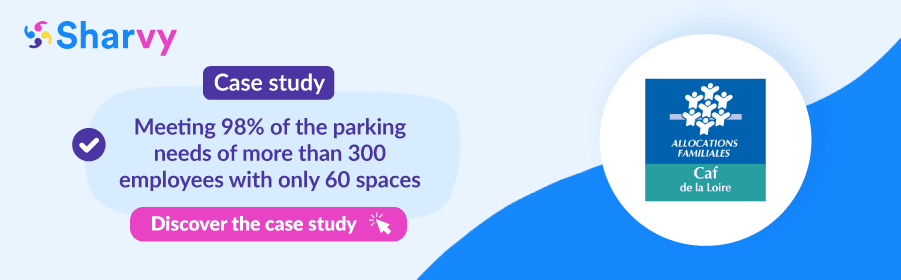
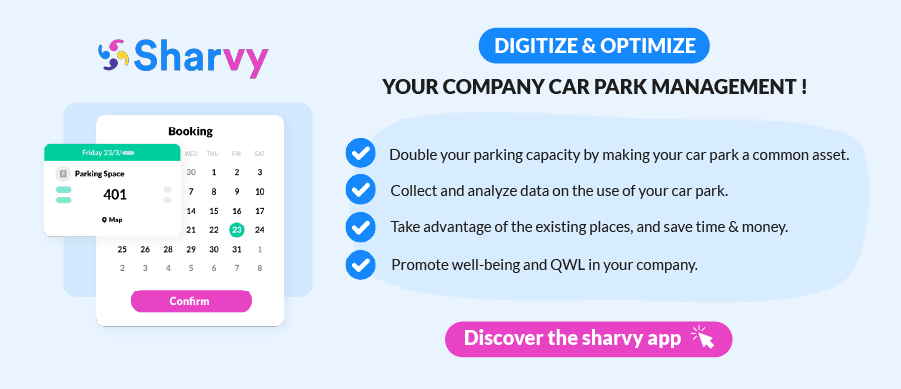
Sharvy allows employees to reserve a parking space based on their days of attendance, whilst giving managers a clear, real-time view of occupancy.
One of the key differentiators is the fair allocation of spaces. Sharvy’s algorithm takes recent usage into account (over a 60-day window) to prevent the same profiles from being systematically prioritised. This ensures a fairer distribution of spaces and reduces frustrations linked to a sense of unequal access.
Beyond this, this approach makes car park management clearer and more efficient: less uncertainty for staff, fewer unused spaces for the company, and smoother overall management.
In line with the concept of service-oriented real estate, the car park is no longer a static space. It becomes a managed service, simple to use and fairer in its day-to-day operation.
↪ The benefits of service-oriented corporate car parks.
A service-oriented car park does more than just optimise spaces: above all, it enhances the overall experience of accessing the site by integrating practical services designed for everyday use.
This starts with essential facilities such as charging points for electric vehicles, which have become indispensable with the rise of electric mobility. The car park then becomes an active infrastructure hub, capable of supporting the transition of fleets and employees.
It also relies on smart access control solutions, which greatly simplify operational management. Number plate recognition, automated barrier opening, or even access via a single button in an app such as Sharvy: the aim is always the same – to eliminate friction at entry and make usage seamless and immediate.
In some cases, the service-oriented car park even forms part of a broader mobility strategy, with complementary services such as company shuttle buses connecting the site to train stations, public transport or high-traffic areas. The car park then becomes a true mobility hub, rather than an isolated stop.
Ultimately, these services profoundly transform the function of the car park: it is no longer just a space where people park, but a smart gateway to the site, connected to the actual uses and needs of employees.
Serviced real estate : can car parks be a key differentiator for businesses?
Beyond its day-to-day operations, the corporate car park plays a much more strategic role than it might seem: it directly influences the way a site is
« perceived » by those who use it.
It is a space that goes unquestioned, until the moment it is lacking. And this is precisely where something interesting comes into play: two companies with equivalent offerings can provide a very different experience simply through the quality of this first physical contact.
In practice, a well-managed car park reduces a form of invisible mental load: no uncertainty, no wasted time, no confusion upon arrival.
It is on this point that solutions such as Sharvy provide real added value within a service-oriented property model. By streamlining access to the car park, simplifying the booking process and making usage more predictable, they help to stabilise the experience of entering the site.
But the impact doesn’t stop there. A better-organised car park also sends a strong internal signal: that of a company which optimises its existing resources rather than simply enduring its constraints. A company which applies logic, transparency and fairness to the use of its spaces.
In an environment where differentiation increasingly hinges on the quality of execution rather than infrastructure alone, this type of issue takes on new significance. The car park thus becomes a discreet yet tangible marker of organisational maturity and attention to the overall experience.
In conclusion
As working practices evolve and employees’ expectations rise, the company car park is establishing itself as an integral part of the site experience.
What was once a technical constraint is gradually becoming a matter of usage, organisation and even perception. And it is precisely this shift that brings it into the realm of service-oriented real estate: an environment where every resource is designed not merely to exist, but to function simply, efficiently and more equitably.
Solutions such as Sharvy illustrate this transition. They enable companies to transform a static space into a service that benefits all users. Ultimately, the question is no longer whether car parking is an important issue. It is about how it is used, perceived and integrated into the site’s overall strategy.
Got a question? Check out the following FAQ!
How do I know if my company car park is under-utilised?
There are several signs that might indicate this: spaces that are regularly unused at certain times, recurring tensions between staff, or a complete lack of visibility regarding actual occupancy rates. Often, the problem isn’t a lack of spaces, but their poor allocation.
Is a car park management system suitable for businesses of all sizes?
Yes, but the challenges differ. In a small organisation, the main focus is on streamlining usage and avoiding friction. In larger organisations, the challenge also extends to optimisation, fair access and the overall management of resources, which is possible via apps such as Sharvy.
How does a solution like Sharvy actually change car park management?
It replaces static management (allocated spaces or spaces left for open use) with a dynamic system based on actual needs. Employees book spaces according to their working days and are allocated spaces (standard, electric, two-wheelers, etc.) via a fair algorithm, whilst managers have a clear, centralised overview of occupancy.
Want to find out more? Check out our latest articles to stay up to date!
Fairness at work : the foundation of the employee experience ?
What is fairness at work? Why is it so important in the workplace? How can fairness be guaranteed? Find the answers here!
Smart building : the benefits for employees and employers!
What is a smart building? What advantages does it offer? What challenges does it address? Find out in this article.

Company relocation : an opportunity to give a fresh start!
Are you about to carry out a company relocation? In this article, find out our top tips for getting the most out of your move.