
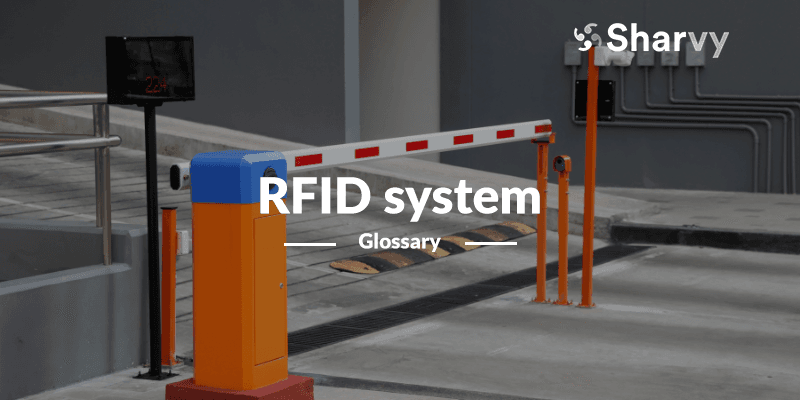
What is an RFID system?
The RFID (Radio Frequency Identification) system is a technology that enables an object (such as an individual) to be identified and authenticated remotely by means of an exchange of radio waves between an electronic chip and a reader.
In the context of professional infrastructures, it often takes the form of access badges, used for example to pass through the barriers of a company car park, or to enter secure buildings.
These devices, integrated with solutions such as the Sharvy application, provide centralised, intelligent management of authorisations. These authorisations, set from the Sharvy interface, are based on a database containing the unique identifiers of each RFID badge.
The administrator, be it the security department or the resource manager, can precisely define access rights: time slots, authorised zones, temporary periods & exceptional restrictions. When an employee presents his or her badge at the car park or building entrance, the reader immediately transmits the information to the system, which checks the validity of the authorisation in real time.
The components and technical operation of an RFID system.
An RFID system is based on 3 essential elements:
- The transponder: integrated into the badge, containing the chip & antenna
- The RFID reader, located at the entrance to a car park or building
- The management software, often hosted in the cloud, responsible for processing the data received and updating the authorisation database.
When the badge is within range of the reader, it activates the chip by electromagnetic induction. The information contained in the badge (unique identifier, access rights, any history) is transmitted to the software.
Integration with solutions such as Sharvy means that this data can be synchronised in real time with parking space management, for example, optimising the flow of access & occupancy of the company car park.
The benefits of RFID in a connected business environment.
There’s no doubt about it: in an intelligent building, as in a modern company car park, the RFID system offers a number of benefits:
- Fluidity: barriers and doors open in a fraction of a second.
- Traceability: every passage is recorded, facilitating auditing and security.
- Remote management: via an interface such as Sharvy, rights can be assigned or revoked instantly.
What’s more, in the context of a company car park, this technology can be used to reserve one-off access for a member of staff or a visitor, while at the same time ensuring accurate monitoring of use.
The limits of the RFID system & technological alternatives.
Despite its advantages, RFID has certain constraints. Badges can be lost, lent out or copied, which means there is a risk of bypassing the system. They also need to be detected from a short distance, which can slow down access in heavy traffic.
For company car parks in particular, some alternative solutions, such as camera-based automatic number plate recognition (ANPR), can offer a smoother experience. This approach dispenses with the need for a badge, allows the vehicle to be opened without stopping completely and reduces hardware maintenance. However, it does involve higher levels of investment, as well as personal data protection considerations.
Ultimately, the choice between RFID & alternative technologies depends on the specific needs of the business, its budgetary constraints, and the degree of integration desired with management platforms such as Sharvy.
Security & data protection when a company uses an RFID system.
The use of RFID badges in a professional environment is not limited to simple access management: it also raises crucial issues of confidentiality & IT security.
Every time a badge is read, it generates time-stamped data which, when centralised in a system like Sharvy, can provide a precise history of a user’s entry and exit.
While this information makes it possible to optimise flow management & reinforce physical security, it must be protected with the utmost rigour. Encryption of exchanges between the reader, the server and the application, as well as strict management of administration rights, are essential to prevent unauthorised access.
In addition, compliance with the General Data Protection Regulation (GDPR) requires companies to limit the retention of historical data to what is strictly necessary, and to clearly inform users about the use of their data. By reconciling technological performance with respect for privacy, RFID retains all its legitimacy in intelligent infrastructures.